Sossusvlei
Overview
Sossusvlei lies within the Namib-Naukluft National Park in western Namibia, inside the Namib Sand Sea, which is inscribed on the UNESCO World Heritage List as the only coastal desert in the world where extensive dune fields are shaped by fog.
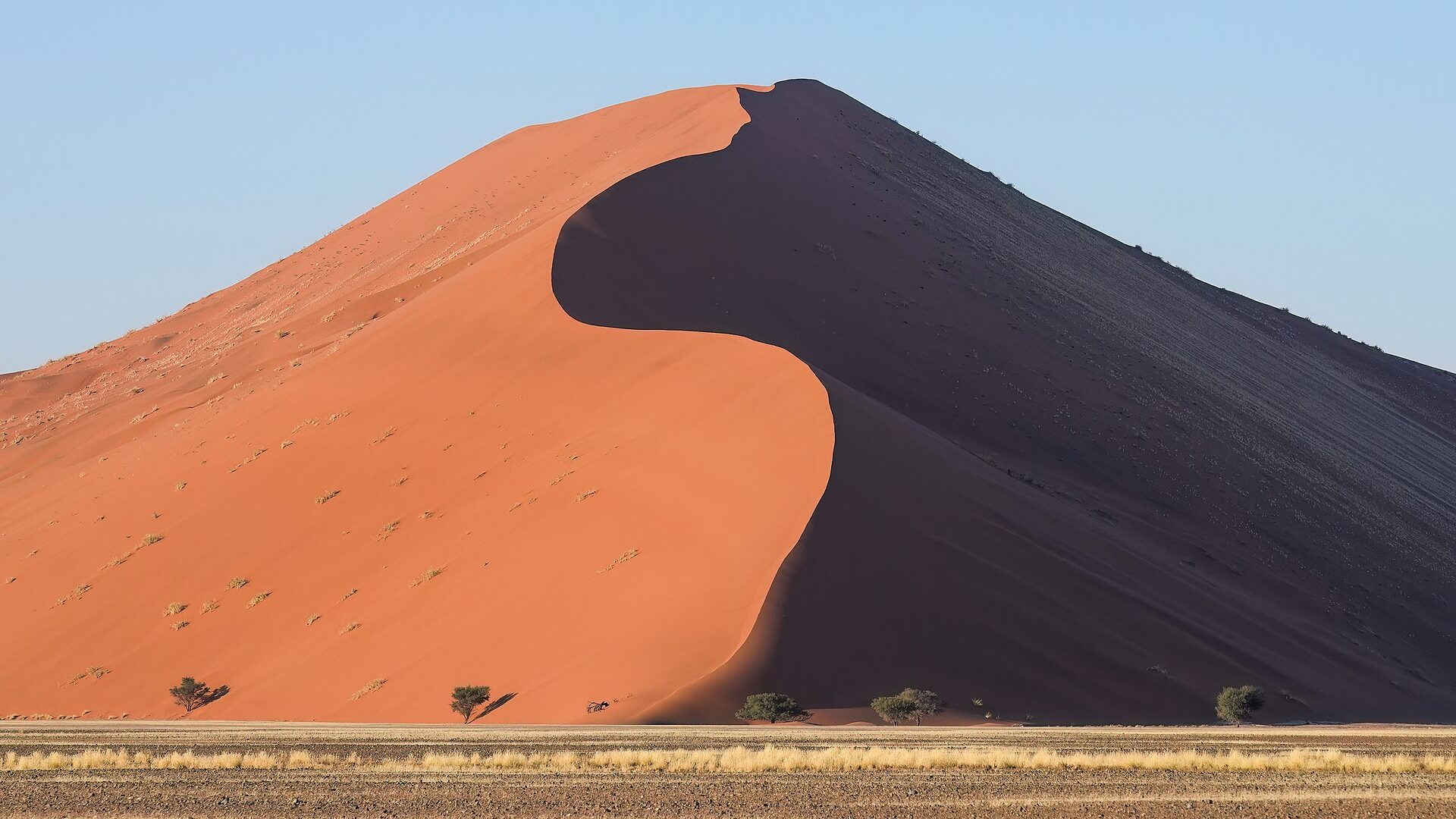
The pan sits at the end of the ephemeral Tsauchab River, which only reaches it after exceptional rain. Around it rise star dunes of great height, coloured deep orange-red by iron oxide in the sand; the older the dune, the redder it is.
The best-known features are Dune 45, beside the access road; Big Daddy, one of the highest dunes in the area; and Deadvlei, a white clay pan studded with the blackened skeletons of camel thorn trees that died centuries ago and have not decayed in the dry air.
Why Visit
Deadvlei at sunrise (black trees, white clay, orange dune, blue sky) is one of the most distinctive landscapes anywhere, and it does not photograph like anywhere else.
The Namib is also among the oldest deserts on earth, and the scale of the dune field takes some time on the ground to register. This is a landscape destination rather than a wildlife one, though oryx, springbok and ostrich are regularly seen.
Top Experiences
- Deadvlei at sunrise. The walk in from the 2x4 car park is about a kilometre over sand; go as early as the gates allow, both for the light and because the surface becomes very hot.
- Climbing Dune 45. The most accessible large dune, at the 45-kilometre mark on the access road, popular for sunrise.
- Big Daddy. A long, steep climb along the ridge above Deadvlei, with a fast descent straight down the face into the pan.
- Sesriem Canyon. A narrow gorge cut by the Tsauchab near the park gate, and a good late-afternoon walk when the dunes are too hot.
- A balloon flight. Dawn flights over the dune field operate from the area and are the clearest way to understand its scale.
- Night skies. The region has some of the darkest skies in the world and several lodges have their own telescopes.
Map
Map data © OpenStreetMap contributors
Best Time to Visit
May to September is the dry, cool season and the most comfortable: clear skies, warm days and cold mornings, often near freezing before sunrise.
October to April is hotter, with daytime temperatures that make dune climbing genuinely hard. Rain is rare but falls mainly between January and April, and can briefly turn the pan into a shallow lake, which is spectacular and unpredictable.
Whatever the month, the useful hours are the first two after sunrise and the last two before sunset. The middle of the day is too hot and the light is flat.
Where to Stay
Inside the park gate at Sesriem is the key distinction: guests staying inside may enter the dune road at sunrise, an hour before visitors staying outside. The NWR campsite and lodge at Sesriem are the options here and book out far ahead.
Just outside the gate are several lodges and camps within a few kilometres, which means an early start but not a long drive.
Further out, towards Solitaire or the Naukluft, are more remote and often more comfortable lodges, at the cost of an hour or more of driving before the gate opens.
Getting There
Sossusvlei is reached by road. From Windhoek the drive is roughly five to six hours on gravel roads via the Spreetshoogte or Remhoogte passes; from Swakopmund, about five hours south.
Most of Namibia's roads outside the main routes are gravel, and a high-clearance vehicle is strongly advised. Distances are long, fuel stops are far apart and there is little mobile coverage.
Small airstrips serve the lodges for fly-in guests, and scheduled light-aircraft transfers operate from Windhoek.
Getting Around
From the Sesriem gate, a sealed road runs about 60 kilometres to the 2x4 car park. The final five kilometres to Sossusvlei itself are deep sand and require 4x4; a shuttle runs this section for those without one.
From the 2x4 car park, Deadvlei is roughly a kilometre on foot across sand. There is no shade and no water on the walk.
Gate times follow sunrise and sunset and are enforced. Plan the return so as to be back through the gate before closing.
Top Attractions
Deadvlei: the white clay pan with dead camel thorn trees, beneath Big Daddy.
Sossusvlei pan: the main pan at the end of the road, occasionally holding water after rain.
Dune 45: the most climbed dune, beside the access road.
Big Daddy and Big Mama: the highest dunes around the pans.
Sesriem Canyon: a narrow gorge a short drive from the gate.
Elim Dune: close to Sesriem and reachable without 4x4, good for a first evening.
Food & Culture
There are no restaurants in the dune area. Meals are taken at lodges and camps, which almost always include breakfast and dinner, and packed breakfasts are provided for early starts.
The nearest supplies are at Solitaire, a small settlement on the road north, known locally for its bakery and its fuel stop, and at Sesriem itself.
Carry far more water than you think you need, several litres per person per day, and something to eat on the dune road, since a morning there easily runs to five hours.
Budget
Namibia is not a cheap destination, mainly because of distance: fuel, vehicle hire and the long drives are unavoidable costs.
Accommodation ranges from the national park campsites, which are inexpensive but must be booked well ahead for the inside-the-gate advantage, to remote luxury lodges at the other extreme. Park entry fees are modest. Balloon flights are the single largest discretionary expense.
Self-driving with a camping setup is substantially cheaper than lodge-based travel and is common in Namibia.
Entry, Tickets & Permits
Entry to the Namib-Naukluft National Park is by permit, bought at the Sesriem gate or included by lodges and tour operators. Park fees are charged per person and per vehicle.
Gate opening and closing are tied to sunrise and sunset and vary through the year; guests staying inside the Sesriem gate may enter the dune road earlier than day visitors.
Check current fees, opening times and road conditions with Namibia Wildlife Resorts or your lodge before travelling, as they change seasonally.
Important Notes
Climb early. Sand surface temperatures become dangerous by mid-morning, and the dunes are far harder work than they look.
Carry water on every walk, including the short one to Deadvlei. There is no water and no shade beyond the car park.
Sun protection is essential: hat, long sleeves, high-factor sunscreen and sunglasses. Reflection off the pale pan is intense.
Mornings are cold. In winter it can be near freezing before sunrise and above 30°C by midday, so dress in layers.
Respect gate times. They are tied to sunrise and sunset and there are penalties for late exit.
The last stretch needs 4x4. Ordinary cars get stuck in the sand every day; use the shuttle instead.
Stay on the marked routes in Deadvlei; the trees are fragile and the pan surface is easily damaged.
Itinerary Suggestions
Two nights is the practical minimum. Arrive in the afternoon, walk Sesriem Canyon or Elim Dune; spend the second morning at Deadvlei and Big Daddy; leave on the third day.
One night gives you a single sunrise and a long drive at both ends, which most people find too tight.
Three nights allows a balloon flight, a second sunrise and time in the middle of the day at the lodge, which is how the heat is best managed.
Sossusvlei fits naturally between Windhoek and Swakopmund on a Namibian loop, often with the Naukluft mountains or the Kalahari either side.
Frequently Asked Questions
Do I need a 4x4 for Sossusvlei
For the last five kilometres to the pan, yes. The rest of the access road is sealed, and a shuttle covers the sand section for visitors without a 4x4.
What is the difference between Sossusvlei and Deadvlei
Sossusvlei is the main pan at the end of the road; Deadvlei is a separate white clay pan nearby with the dead camel thorn trees, and is what most photographs show.
Should I stay inside the Sesriem gate
If sunrise at Deadvlei matters to you, yes. Guests inside the gate can start an hour before day visitors, which is the difference between arriving with the light and arriving after it.
How hard is climbing Big Daddy
It is a steep climb of some hundreds of metres in soft sand, typically an hour or more. Start at first light; it becomes unsafe in the heat.
Plan your trip to Sossusvlei
Free tools for flight times, time differences, budget, money and plugs.
- Flight Duration CalculatorWork out real flight time across time zones.
- Time Zone ConverterFind the time in another city instantly.
- Trip Budget CalculatorEstimate your total trip cost, item by item.
- Currency ConverterConvert prices between currencies at indicative rates.
- Travel Plug & Voltage CheckerCheck if you need a plug adapter or voltage converter.
- Jet Lag CalculatorEstimate how many days you need to beat jet lag.