
🇹🇷 Turkey
Istanbul’s bridge between continents, Cappadocia’s balloons, and Aegean coastline.

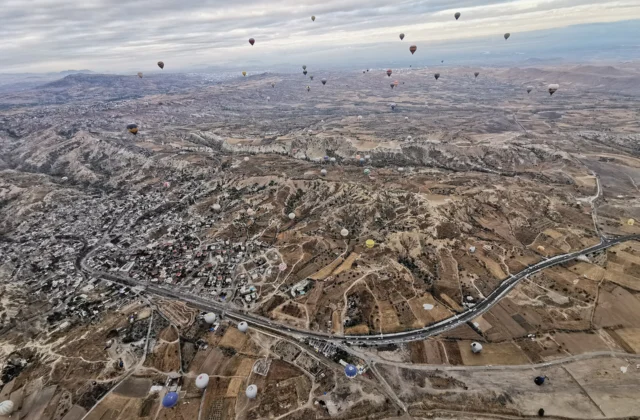
Turkey straddles Europe and Asia at Istanbul, and pairs that city’s Byzantine-Ottoman layers with Cappadocia’s hot-air-balloon landscapes and a long, beautiful Aegean and Mediterranean coastline.
Best Time to Visit
April to early June and September to October are the two windows that work almost everywhere in Turkey at once: warm without being punishing, and outside the peak crowding of high summer.
Summer is hot and busy. The Aegean and Mediterranean coasts are at their best for swimming and their worst for queues and prices. Central Anatolia, including Cappadocia, gets very hot by day and stays pleasant at night.
Winter reveals a country most visitors never see. Istanbul in January is cold, grey and dramatically less crowded. Cappadocia under snow is genuinely spectacular, and the season when balloon flights are cancelled most often. Eastern Anatolia is severe.
Two scheduling notes. Turkey is large: the coast, Cappadocia and the east are different climates, not variations on one. And Ramadan shifts each year: it changes opening hours and the rhythm of the day, without closing anything to visitors.
Weather & Climate
Turkey holds several climates that have little to do with each other. The Aegean and Mediterranean coasts are Mediterranean in the textbook sense: hot dry summers, mild wet winters, and swimmable sea well into October.
The Black Sea coast is the outlier: genuinely wet, green and humid year-round, which is why the tea and hazelnuts grow there.
Central Anatolia, where Cappadocia sits at around 1,000 m, is a steppe climate: hot days and cool nights in summer, hard frosts and snow in winter, and a wide daily swing in every season. Eastern Anatolia is higher and colder again, with winters that close mountain roads.
Istanbul sits between systems and gets a bit of everything: humid summers, damp winters, and the wind off the Bosphorus that makes February feel colder than the number suggests.
Map
Map data © OpenStreetMap contributors
Top Cities
Popular Destinations
Entry & Visa Guidance
Turkey removed visa requirements for many nationalities in recent years, and the rules now vary considerably by passport. Nationals of many European countries, including the UK, can enter for up to 90 days in any 180-day period for tourism or business without a visa. Others still need an e-visa, obtained online before travel from the official government portal.
The passport validity rule is unusual and catches people out. Turkey requires a passport valid for at least 150 days beyond your arrival date, plus at least one blank page. This is not the six-month rule most countries use and not the three-month rule used across much of Europe — check it specifically rather than assuming.
At land borders, make sure your passport is actually stamped and dated before you leave the post.
Two further points worth knowing:
- Currency limits. You may not take Turkish lira worth more than the equivalent of USD 5,000 out of the country, and foreign currency above USD 5,000 must be declared.
- Day trips to the Greek islands from the Aegean coast now involve EU Entry/Exit System formalities on the Greek side.
The UK FCDO advises against travel to some regions of Turkey, principally near the Syrian border. Check your own government’s current advice, including its regional map, before booking. Details above reflect UK FCDO guidance updated 22 July 2026.
Getting There & Around
Getting there. Istanbul Airport (IST) is Turkish Airlines’ hub and one of the largest transfer airports in the world; Sabiha Gökçen (SAW) sits on the Asian side and handles most low-cost traffic. Note that the two are roughly 70 km apart with the Bosphorus in between — booking an outbound from one and a return to the other is a mistake worth avoiding.
Domestic flights are frequent, cheap and the standard way to cover distance. Istanbul to Kayseri or Nevşehir for Cappadocia takes about 90 minutes and costs a fraction of the time by road.
High-speed rail (YHT) links Ankara with Istanbul, Konya and Eskişehir, and is comfortable and punctual. The network does not yet reach the coasts or the east.
Long-distance buses remain the backbone of Turkish travel: extensive, inexpensive, and considerably better equipped than the equivalent in most of Europe. Overnight routes are normal.
Locally, the dolmuş: a shared minibus running a fixed route and leaving when full — fills the gaps that timetabled transport does not.
Approximate Travel Budget
Turkey has been inexpensive for foreign visitors in recent years, but the lira has been volatile and prices in local currency move quickly. Any figure quoted in lira dates fast; think in terms of relative cost instead.
What stays true: food, domestic transport and museum entry are cheap relative to Western Europe. Accommodation in Istanbul’s tourist districts and cave hotels in Cappadocia are priced internationally and are the exception. The single largest discretionary cost in most Turkey itineraries is a balloon flight over Cappadocia.
The Museum Pass schemes — separate versions for Istanbul, Cappadocia and other regions — are worth checking against your route, as major sites are individually ticketed.
Cards are accepted almost everywhere in cities. Markets, dolmuşes, and small towns run on cash. Exchange rates at the airport are consistently poor.
Local Customs & Culture
Turkey is a secular republic with a Muslim-majority population, and social norms vary enormously between coastal resorts, Istanbul's cosmopolitan districts and conservative Anatolian towns. Read the room rather than the country.
Mosque etiquette is straightforward and worth getting right: remove shoes, dress modestly, and women cover their hair. Most major mosques provide scarves at the entrance. Avoid visiting during the five daily prayer times and especially during Friday midday prayers.
Hospitality is offered constantly and refusing tea can read as a rebuff. Accepting a glass and staying a few minutes is the graceful answer, and in shops it does not oblige you to buy anything.
Shoes come off when entering a home, always.
Bargaining is expected in bazaars and carpet shops and inappropriate in ordinary retail, restaurants and supermarkets.
On photography: ask before photographing people, and do not photograph military installations or personnel. In the southeast in particular this matters.
One subject to leave alone: political topics, and questions about Atatürk, Kurdish politics or the Armenian question, are not casual conversation with strangers.
Food
Turkish cooking is regional to a degree that surprises people who arrive expecting kebabs. Gaziantep in the southeast is a UNESCO City of Gastronomy and does things with pistachios and lamb that have no equivalent on the coast. The Black Sea cooks with anchovies, cornmeal and butter. The Aegean is olive oil, herbs and vegetables.
Breakfast is the meal to understand first. A Turkish kahvaltı is a table covered in small plates — cheeses, olives, tomatoes, cucumber, honey with clotted cream, eggs, jams, bread — and it takes two hours. It is not a hotel buffet.
Meze works the same way at the other end of the day, alongside rakı, the aniseed spirit that turns cloudy with water.
Kebab covers dozens of distinct regional dishes, most of which are not what the word means abroad. İskender, Adana, Urfa and beyti are different things.
Tea, not coffee, is the everyday drink: served in tulip glasses, constantly, and often refused three times before being accepted. Turkish coffee is a separate, ceremonial occasion.
Safety & Travel Advice
Turkey is visited by tens of millions of people a year and the tourist regions are well set up. The realistic concerns are specific rather than general.
Regional travel advice matters here more than in most countries. Several governments advise against travel to areas near the Syrian border, and some advise against all but essential travel to parts of the southeast. These advisories are regional, not national, and they are updated regularly; check the current map before you book anything in the east.
Earthquakes are a genuine risk. Turkey sits on major fault lines and the 2023 earthquakes in the southeast caused catastrophic damage. Know the basic response and check the seismic guidance for your region.
Traffic is the most likely everyday hazard. Pedestrian crossings do not confer priority in practice, and intercity driving standards vary.
Scams affecting visitors cluster in Istanbul: the shoeshine-brush drop, the invitation from a friendly stranger to a bar where the bill arrives at many times the menu price, and inflated taxi fares. Ride-hailing apps remove the last of these entirely.
Balloon flights in Cappadocia are regulated by the civil aviation authority and grounded when conditions are unsuitable. Treat a cancellation as the system working, not as an obstacle to argue with.
Useful Phrases
Hello: Merhaba
Thank you: Teşekkür ederim (or the easier: Sağ ol)
Please: Lütfen
Yes / No: Evet / Hayır
How much?: Ne kadar?
The bill, please: Hesap, lütfen
Excuse me: Affedersiniz
Water: Su
I don't understand: Anlamıyorum
No, thank you: Hayır, teşekkürler
Official Sources
Visa, entry, and safety information changes. Always verify with the official sources below before you travel.