
🇧🇪 Belgium
Belfries, beer halls and art nouveau in a small country built for train travel

Belgium packs an extraordinary amount into a small space: medieval market squares, Flemish masters, art nouveau townhouses, comic-strip murals and a food culture taken very seriously. Distances are short and the rail network is dense, so a week can take in several very different cities without ever hiring a car.
Best Time to Visit
Late spring (May–June) and early autumn (September) are the most comfortable times for city walking: long days, terrace weather and fewer crowds than high summer. July and August bring festivals and the busiest streets, especially in Bruges, where day visitors fill the centre from late morning.
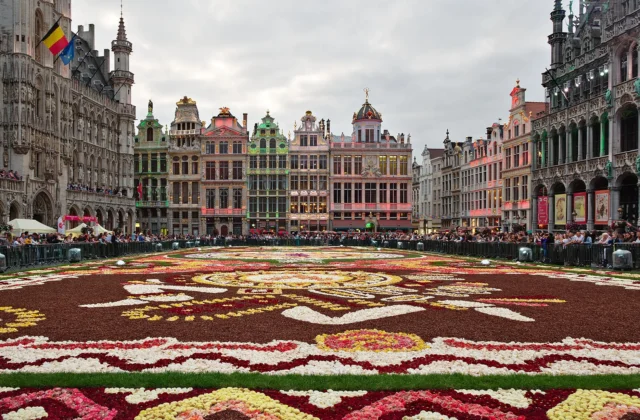
Winter is grey and often damp, but December has its own appeal, with Christmas markets and lights in Brussels, Bruges, Ghent and Antwerp. Museums, beer cafés and chocolate shops make Belgium a good choice for a short break in any season. In even-numbered years, Brussels lays its famous flower carpet across the Grand-Place in August.
Weather & Climate
Belgium has a temperate maritime climate: mild summers, cool winters and rain spread throughout the year rather than concentrated in one season. Weather can change several times in a day, so a light waterproof layer is useful even in summer.
The coast is breezier and slightly milder in winter, while the hills of the Ardennes in the south-east are cooler, with occasional snow in the colder months.
Map
Map data © OpenStreetMap contributors
Top Cities
Entry & Visa Guidance
Belgium is part of the Schengen Area and the European Union. EU, EEA and Swiss citizens can travel with a valid passport or national ID card. Many other nationalities, including UK, US, Canadian and Australian citizens, can visit without a visa for up to 90 days in any 180-day period across the whole Schengen Area; others need a Schengen visa, applied for through the Belgian embassy or consulate responsible for their country of residence.
The US State Department advises that passports should be valid for at least three months beyond your planned departure from the Schengen Area. Since 10 April 2026, the EU Entry/Exit System (EES) has been fully operational at Schengen external borders: non-EU visitors on short stays are registered with fingerprints and a facial image instead of passport stamps. ETIAS, the planned travel authorisation for visa-exempt visitors, is not yet in force; the EU has said it will start in the last quarter of 2026, with the exact date still to be announced.
Confirm the current rules for your nationality with the official source before booking. Checked October 2026.
Getting There & Around
Trains are the backbone of travel in Belgium. The national operator SNCB/NMBS connects all the main cities, and tickets can be bought in the SNCB app or from station machines; discounted fares exist for under-26s and over-65s. From Brussels Airport, trains leave from the station beneath the terminal and reach Brussels-North in about 11 minutes and Brussels-Central in about 18; Leuven, Antwerp and Ghent also have direct services. Journeys to or from the airport station carry a Brussels Airport supplement of €6.90, usually built into the ticket price (fee checked October 2026).
Brussels-South (Midi) is the hub for high-speed international trains, with direct links to France, the Netherlands, Germany and London. Within Brussels, metro, trams and buses cover the city; Bruges is best explored on foot or by bike. A car is only really useful for the Ardennes; city centres are congested and several, including Brussels, operate low-emission zones with registration rules for foreign vehicles.
Approximate Travel Budget
Belgium is a mid-to-high-cost destination, broadly in line with its neighbours in western Europe. Accommodation is the largest expense, and prices in Brussels rise during the week when EU institutions are busy, while weekend rates are often softer; Bruges is most expensive on summer and December weekends.
Savings are easy to find: rail travel between cities is good value compared with driving and parking, lunchtime set menus are cheaper than dinner, and a cone of fries or a bakery sandwich makes a satisfying light meal. Many churches and squares are free to enjoy, while museum passes in the larger cities can cut costs if you plan several visits.
Local Customs & Culture
Belgium has three official languages, and language is a sensitive subject. Dutch is spoken in Flanders (including Bruges, Ghent and Antwerp), French in Wallonia, both in Brussels, and German in a small eastern area. If you are unsure which to use, a polite greeting followed by English is usually better received than the “wrong” language.
A greeting when entering a shop or café is expected. In restaurants, service is normally included in the bill, and rounding up or leaving a little extra for good service is appreciated rather than required. Beer is taken seriously: many brews are served in their own branded glass, and strong abbey and Trappist styles are meant to be sipped, not rushed.
Food
Belgian food is hearty, generous and quietly refined. Moules-frites (mussels with fries) is the classic, alongside carbonnade flamande, a beef stew cooked in beer, and waterzooi, a creamy stew of chicken or fish from Ghent. Fries (frites/friet) are a national institution, twice-fried and served in a paper cone from a friterie or frituur with a choice of sauces.
Waffles come in two main styles: the light, rectangular Brussels waffle and the denser, caramelised Liège waffle. Chocolate shops range from historic pralines makers to inventive small producers, and speculoos biscuits accompany many a coffee. Belgium's beer culture is one of the richest in the world, from Trappist ales to sour lambics brewed around Brussels. In Bruges, look beyond the main square for quieter brasseries and beer cafés.
Safety & Travel Advice
Belgium is generally safe for visitors, and most problems are opportunistic. Pickpocketing and bag theft are the main risks, especially in Brussels, around the big railway stations, on the metro and on busy international trains. Keep valuables close and carry only what you need for the day.
Demonstrations take place fairly often in Brussels, usually around the government and European districts; it is sensible to avoid them. As in other European countries, there is a background risk of terrorism, and the authorities may raise alert levels at short notice. In an emergency call 112; the police can also be reached on 101. Check your own government's travel advice before you go.
Useful Phrases
Dutch is spoken in Flanders and French in Wallonia; both are used in Brussels.
Goeiedag (Dutch): Hello / good day
Dank u wel (Dutch): Thank you
Alstublieft (Dutch): Please / here you are
Excuseer (Dutch): Excuse me
Schol! (Dutch): Cheers!
Bonjour (French): Hello / good day
Merci beaucoup (French): Thank you very much
S'il vous plaît (French): Please
L'addition, s'il vous plaît (French): The bill, please
Parlez-vous anglais ? (French): Do you speak English?
Official Sources
Visa, entry, and safety information changes. Always verify with the official sources below before you travel.
- https://travel.state.gov/content/travel/en/international-travel/International-Travel-Country-Information-Pages/Belgium.html
- https://home-affairs.ec.europa.eu/policies/schengen/smart-borders/entry-exit-system_en
- https://www.eeas.europa.eu/eeas/coming-visa-free-country-and-travelling-europe_en
- https://whc.unesco.org/en/statesparties/be
- https://www.brusselsairport.be/en/passenger/mobility/public-transport/train
- https://www.belgiantrain.be/en/tickets-and-railcards/
- https://statbel.fgov.be/en/themes/population/structure-population
Plan your trip to Belgium
Free tools for flight times, time differences, budget, money and plugs.
- Flight Duration CalculatorWork out real flight time across time zones.
- Time Zone ConverterFind the time in another city instantly.
- Trip Budget CalculatorEstimate your total trip cost, item by item.
- Currency ConverterConvert prices between currencies at indicative rates.
- Travel Plug & Voltage CheckerCheck if you need a plug adapter or voltage converter.
- Jet Lag CalculatorEstimate how many days you need to beat jet lag.