
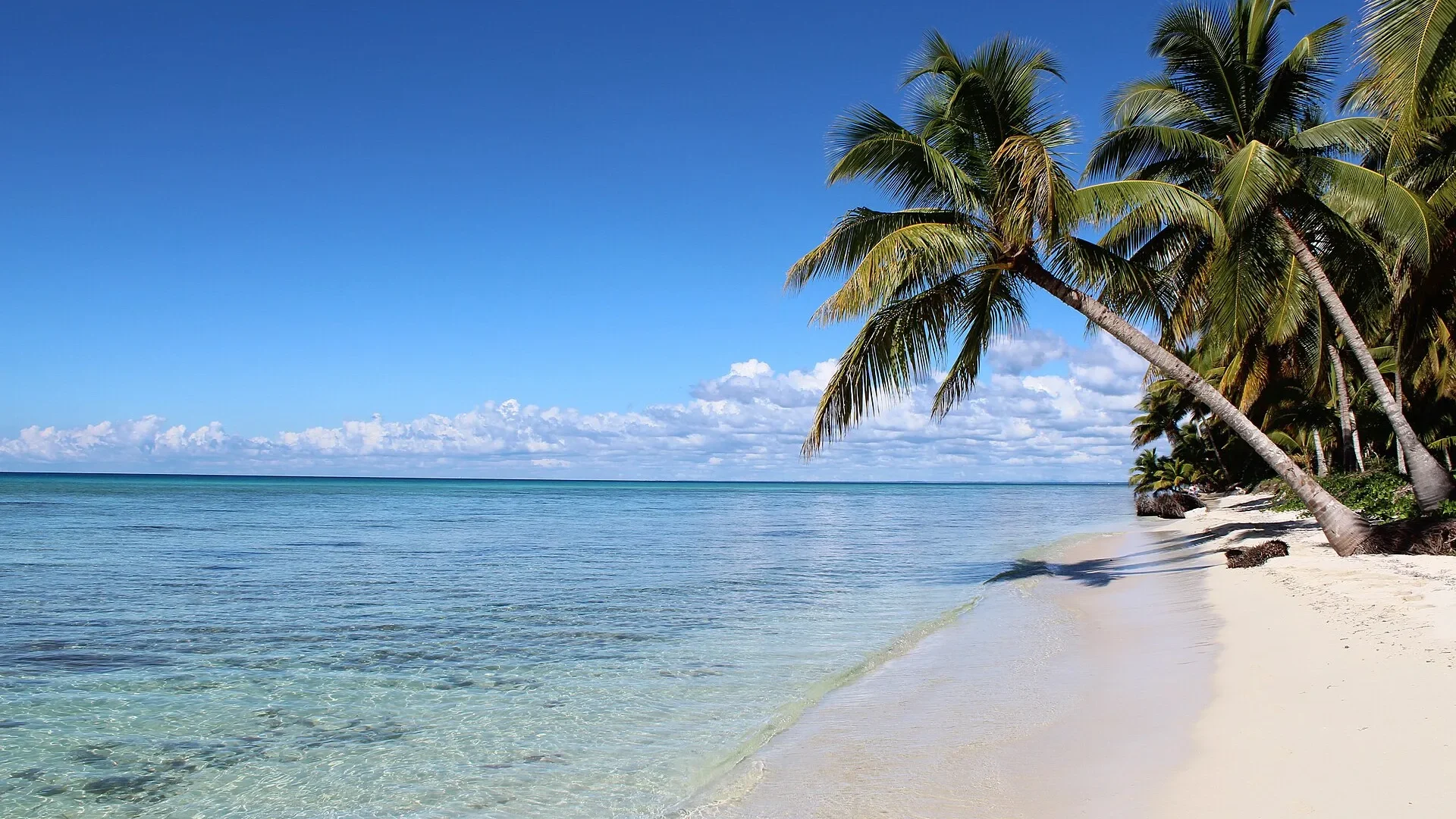
🇩🇴 Dominican Republic
Punta Cana’s resorts and the colonial heart of Santo Domingo.
The Dominican Republic shares the island of Hispaniola with Haiti and contains both the most developed resort industry in the Caribbean and the highest mountain in the region, Pico Duarte, at over 3,000 metres.
The two halves of a trip here rarely meet. Punta Cana in the east is an all-inclusive coast; Santo Domingo’s colonial Zona Colonial is the oldest permanent European settlement in the Americas and a UNESCO World Heritage site; Samaná, Jarabacoa and the southwest are something else again.
Best Time to Visit
December to April is the dry season and high season: hot, sunny, low humidity, highest prices.
May to November is wetter and hotter, with rain typically as afternoon showers, and noticeably cheaper.
Hurricane season runs 1 June to 30 November, peaking August to October. The north coast is more exposed than the south.
Humpback whales gather in Samaná Bay roughly from mid-January to mid-March, which is one of the best land-based whale-watching seasons anywhere and a genuine reason to time a trip.
Weather & Climate
Tropical, hot and humid at sea level year-round, with the trade winds making the coasts more comfortable than the interior.
The Cordillera Central changes the picture completely: Jarabacoa and Constanza sit at altitude, are cool enough for pine forest and strawberry farming, and can be cold at night. Visitors heading inland are regularly surprised by it.
Rainfall varies sharply by region. The north and east coasts are wetter; the southwest around Barahona and Pedernales is dry and semi-arid, with cactus scrub and salt flats.
Map
Map data © OpenStreetMap contributors
Explore More in the Region


Entry & Visa Guidance
UK Foreign Office guidance states that you can visit for tourism without a visa for 30 days, extendable up to 120 days through the immigration service. Overstaying without an extension results in a charge on departure.
All travellers must complete the electronic entry and exit form (e-Ticket), available on the official migration portal, up to seven days before arrival. It combines the customs declaration with the arrival and departure information and produces a QR code shown at check-in or at the border.
Fingerprints and a photograph are taken on entry, and proof of onward or return travel may be requested. Check vaccination requirements, which may include a yellow fever certificate depending on your routing, at least eight weeks before travelling.
Confirm the current passport validity rule and your own nationality's position with the Dominican immigration authority before booking, as these have been revised.
Getting There & Around
Distances are longer than the island's size suggests, and the road from Santo Domingo to Punta Cana or to Samaná is a real journey rather than a transfer.
Caribe Tours and Metro Tours run comfortable, cheap intercity coaches and are the easiest option for visitors without a car. Guaguas: minibuses running fixed routes, are the local alternative, very cheap and crowded.
Hire cars are available; driving is assertive, motorbikes weave constantly, and rural roads are unlit at night with livestock and pedestrians on the carriageway. Avoid driving after dark outside cities.
Motoconchos, motorbike taxis, are ubiquitous for short hops and rarely provide helmets. Domestic flights and the Samaná ferry cut the longest transfers. Santo Domingo has a two-line metro that is clean and useful within the capital.
Approximate Travel Budget
The country splits between the all-inclusive economy and the local one, and the gap is wide. Inside a Punta Cana resort, the daily cost is fixed and international; outside, eating and travelling are inexpensive.
Best value: comedores and local restaurants serving la bandera, the standard lunch plate; the intercity coaches; and guesthouses in Las Terrenas, Cabarete, Jarabacoa or the Zona Colonial, which cost a fraction of resort rates.
Where money goes: resort rates in high season, excursions booked through hotels rather than locally, and long private transfers.
Tipping: a service charge plus tax is commonly added to restaurant bills; extra is optional. Small tips for guides and drivers are customary.
Local Customs & Culture
Dominicans are warm, loud and physically expressive, and greetings matter: a handshake or a kiss on the cheek, and a buenos días before any question.
Merengue and bachata are national music forms and dancing is a social skill rather than a performance; being unable to dance is treated as mildly funny and no obstacle.
Baseball is the national sport and the winter league is followed intensely. Conversation about it will get you further than almost anything else.
Modest dress away from the beach is appreciated, particularly in the Zona Colonial's churches. Haitian-Dominican relations are a sensitive subject with a difficult history; it is a topic to listen to rather than opine on.
Food
La bandera dominicana: rice, red beans, stewed meat and salad, is the everyday lunch and the national plate. Sancocho is the celebratory stew of several meats and root vegetables.
Other staples: mangú, mashed plantain eaten at breakfast with fried cheese, salami and egg; tostones and yuca; chicharrón; and pescado frito along the coast, often with coconut sauce in Samaná, where the French-influenced cooking of the peninsula stands out.
Fruit is exceptional (mango, passion fruit, chinola, zapote) and morir soñando, orange juice with milk, is the local drink to try. Dominican coffee and cacao are both serious agricultural products.
Rum is excellent; the president-brand beer is the social default. Tap water is not drunk.
Safety & Travel Advice
Most visits are trouble-free, particularly within resort areas. Petty theft and opportunistic robbery are the main risks, concentrated in parts of Santo Domingo and in crowded areas; violent crime exists but is not generally directed at tourists.
Practical habits: use hotel or app-based taxis rather than hailing on the street after dark, do not display valuables, and use hotel safes. Read your own government's current advice for specific areas.
Road traffic is the most statistically significant danger for visitors, both as driver and as passenger. Avoid motoconchos where you can.
In the sea, rip currents affect several north-coast beaches and many have no lifeguards. Mosquito-borne illness including dengue is present; use repellent. Drink bottled or treated water.
The land border with Haiti and the areas around it are subject to specific travel advisories. Check the current guidance before approaching that region.
Useful Phrases
Spanish is the language and English is confined largely to resorts. Dominican Spanish is fast and drops consonants, which takes adjustment.
Buenos dias / buenas tardes / buenas noches - good morning / afternoon / evening.
Por favor - please. Gracias - thank you.
Cuanto es - how much is it.
La cuenta, por favor - the bill, please.
Que lo que - what's up (very common informal greeting, contracted to klk in writing).
Ahora - now, but often meaning later; ahorita can mean either sooner or later depending on tone.
Guagua - bus or minibus. Motoconcho - motorbike taxi. Colmado - corner shop.
Un chin - a little bit.
Donde esta el bano - where is the toilet.
Official Sources
Visa, entry, and safety information changes. Always verify with the official sources below before you travel.
Plan your trip to Dominican Republic
Free tools for flight times, time differences, budget, money and plugs.
- Flight Duration CalculatorWork out real flight time across time zones.
- Time Zone ConverterFind the time in another city instantly.
- Trip Budget CalculatorEstimate your total trip cost, item by item.
- Currency ConverterConvert prices between currencies at indicative rates.
- Travel Plug & Voltage CheckerCheck if you need a plug adapter or voltage converter.
- Jet Lag CalculatorEstimate how many days you need to beat jet lag.