🇿🇦 South Africa
Safari, wine country, and two oceans meeting at the tip of the continent.

South Africa packs an unusual range into one country: two coastlines on different oceans, mountain and desert interiors, world-class wine country, and big-game reserves that can be visited without a guide in your own car.
It also has three capital cities (Pretoria for the executive, Cape Town for the legislature, Bloemfontein for the judiciary) twelve official languages, and a recent history that shapes everything a visitor sees. Understanding a little of it before arriving changes the trip substantially.
Best Time to Visit
Seasons are reversed from the northern hemisphere, and the best months differ by region.
For safari in the Kruger and the northeast, the dry winter from May to September is best: vegetation thins, animals concentrate at water, and malaria risk is lower.
For Cape Town and the Garden Route, the summer from November to March is warm and dry, with December and January the domestic holiday peak. Spring, September to November, brings the wildflowers of Namaqualand.
Whale watching along the Western Cape coast, particularly at Hermanus, runs roughly from June to November.
The two priorities conflict: safari is best in winter, the Cape is best in summer. A trip covering both is a compromise, and the shoulder months of April to May or September to October are the usual answer.
Weather & Climate
South Africa is mostly temperate rather than tropical, moderated by altitude: much of the interior sits on a high plateau above 1,000 metres.
The Western Cape has a Mediterranean climate with winter rainfall and hot, dry summers, which is why the wine regions are there. The rest of the country has summer rainfall, often as dramatic afternoon thunderstorms. The east coast around Durban is subtropical and humid.
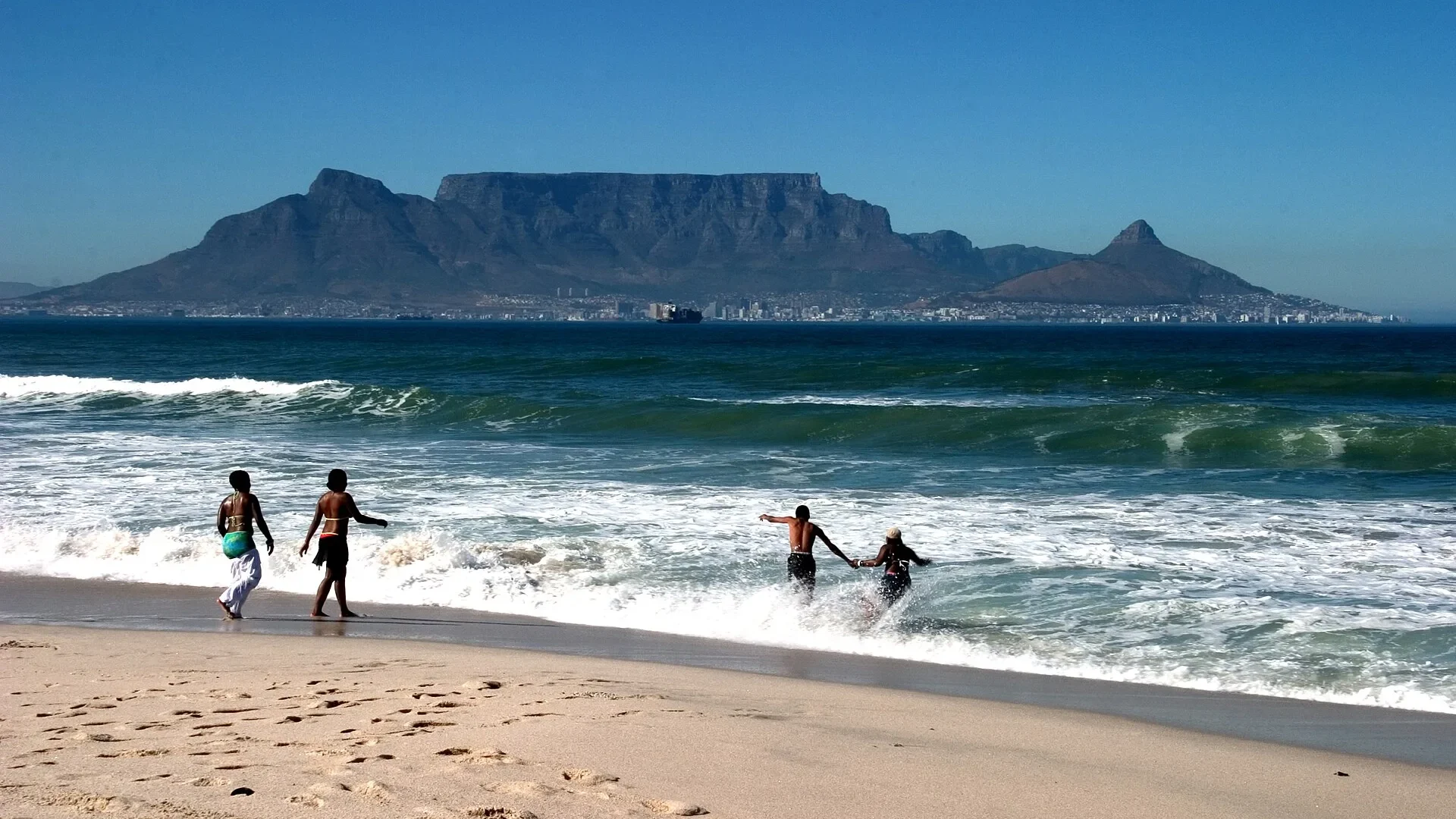
Winter nights in the interior and the Drakensberg drop below freezing, and snow falls on the higher mountains. The Cape's summer southeaster, known locally as the Cape Doctor, is a strong wind that can close the Table Mountain cableway.
Map
Map data © OpenStreetMap contributors
Top Cities
Entry & Visa Guidance
Many nationalities can enter South Africa visa-free for tourism for a limited period; others require a visa applied for in advance. Check your own nationality with the Department of Home Affairs before booking.
Passports generally need at least two blank pages for entry stamps and validity beyond the intended stay: travellers have been refused boarding over the blank-page requirement, so check this specifically.
South Africa enforces documentation rules for children under 18, which can include an unabridged birth certificate and, where only one parent is travelling, parental consent. Requirements have been amended over time; verify the current position with Home Affairs, as airlines apply them strictly.
Malaria prophylaxis is worth medical advice for the low-lying northeast including the Kruger, particularly in the wet summer months. Yellow fever proof may be required if arriving from a country with transmission risk.
Getting There & Around
Self-driving is the normal way to see South Africa and is straightforward: roads are good on the main routes, signage is in English, and driving is on the left. It is what makes a self-guided Kruger safari or the Garden Route possible.
Practical driving points: distances are long, fuel stations are attended rather than self-service, and many are cash-preferred for the attendant's tip. Avoid driving long distances after dark because of unlit vehicles, livestock and pedestrians on rural roads.
Domestic flights link Johannesburg, Cape Town, Durban and Port Elizabeth cheaply and frequently. Intercity coaches are comfortable and inexpensive. Long-distance rail is limited, with the notable exception of luxury tourist services.
In cities, ride-hailing apps are widely used and are the recommended alternative to walking at night or using minibus taxis, which are the local mass transport and are not designed for visitors with luggage.
Approximate Travel Budget
South Africa offers unusually good value for visitors from strong-currency countries. Restaurant meals, wine, fuel and mid-range accommodation all cost considerably less than the European or North American equivalent.
The expensive elements are private game reserves, which are all-inclusive and priced internationally, and domestic flights booked late.
The significant saving is that a self-drive safari in a national park such as the Kruger (park entry, a rest camp and your own car) costs a small fraction of a private lodge, and the wildlife is the same animals in the same landscape.
Local Customs & Culture
South Africa has twelve official languages. English is widely spoken and is the common language of business and tourism; Afrikaans, isiZulu and isiXhosa are the most widely spoken others, and a greeting in the local language is warmly received.
The country's history is recent and present. Museums that address it (the Apartheid Museum in Johannesburg, the District Six Museum in Cape Town, Robben Island, the Hector Pieterson Museum in Soweto) are among the most worthwhile things to do here and are not optional extras to the beaches and wildlife.
Socially: the braai is a genuine institution rather than a barbecue, tipping is expected at around ten per cent in restaurants and for petrol attendants and car guards, and photography of people should be preceded by asking.
Food
South African food reflects Indigenous, Dutch, Malay, Indian and British influences. The braai is the social centre of it, with boerewors sausage, steak and pap, a maize porridge.
Cape Malay cooking, developed by enslaved people brought from Southeast Asia, gives the Cape its distinct dishes (bobotie, bredie, koeksisters) mildly spiced and slightly sweet. Durban's large Indian population produced bunny chow, a hollowed loaf filled with curry, and one of the strongest curry traditions outside India.
Snacks and staples to try: biltong and droëwors, air-dried meats unlike American jerky; rooibos, a caffeine-free red bush tea grown only in the Cederberg; and the Cape winelands around Stellenbosch and Franschhoek, which are close enough to Cape Town for a day trip.
Safety & Travel Advice
Crime levels are high by international standards and this is the aspect that most requires planning. It is also very unevenly distributed, and most visits pass without incident.
Practical habits: use ride-hailing rather than walking after dark in cities, do not display phones, jewellery or bags, keep car doors locked and valuables out of sight at junctions, use ATMs inside malls or banks rather than on the street, and never accept help at an ATM.
Hiking on Table Mountain and Lion's Head should be done in groups and on established routes; muggings have occurred on quieter paths. Use the cableway or well-used trails and check conditions, as weather changes fast on the mountain.
On the coast, currents are strong and shark-spotter programmes operate at some Cape beaches, follow the flag and siren system. Read your own government's current advice for the specific areas you plan to visit.
Useful Phrases
English is widely spoken. These are courtesies in the other most common languages, and South African English terms you will hear constantly.
Sawubona - hello (isiZulu). Molo - hello (isiXhosa). Hallo / Dankie - hello / thank you (Afrikaans).
Enkosi - thank you (isiXhosa). Ngiyabonga - thank you (isiZulu).
Local English:
Robot - traffic light. Braai - barbecue. Bakkie - pickup truck.
Now now / just now - soon, but not immediately; the two differ and neither means now.
Lekker - good, nice, enjoyable. Shame - an expression of sympathy or affection, not criticism.
Howzit - how are you, used as a greeting.
Official Sources
Visa, entry, and safety information changes. Always verify with the official sources below before you travel.
Plan your trip to South Africa
Free tools for flight times, time differences, budget, money and plugs.
- Flight Duration CalculatorWork out real flight time across time zones.
- Time Zone ConverterFind the time in another city instantly.
- Trip Budget CalculatorEstimate your total trip cost, item by item.
- Currency ConverterConvert prices between currencies at indicative rates.
- Travel Plug & Voltage CheckerCheck if you need a plug adapter or voltage converter.
- Jet Lag CalculatorEstimate how many days you need to beat jet lag.