
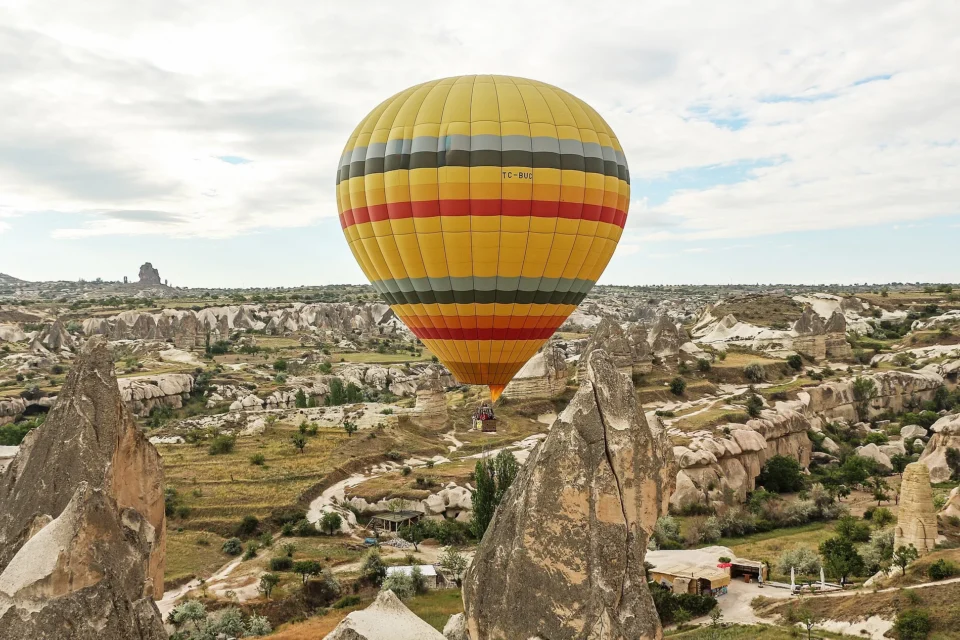
The balloons over Cappadocia are the reason a large share of visitors book the trip, and they are the one part of it nobody can promise you. Flights are cancelled regularly, sometimes for several consecutive mornings, and the decision is made a couple of hours before dawn by people who are not going to change their minds because you fly home tomorrow.
Understanding what that decision rests on is the difference between building an itinerary that absorbs a cancellation and one that is ruined by it.
Who actually decides
Ballooning in Turkey is regulated by the Directorate General of Civil Aviation (SHGM). Operators must be licensed, pilots must be certified, and permission to fly is issued for a given morning rather than standing indefinitely. When conditions fall outside the permitted envelope, flights are grounded.
This matters because it removes the argument. Your operator is not choosing to disappoint you and cannot be persuaded otherwise. A cancellation is the regulatory system working as intended over a landscape where balloons launch in large numbers within a small area.
What grounds a flight
Wind: the main reason by far
Balloons have no steering. A pilot controls altitude, and uses the fact that wind direction and speed differ at different heights to choose a course. That technique needs the wind to be light and predictable at several levels at once.
Surface wind matters most at the two moments the balloon is closest to the ground: inflation and landing. A breeze that feels unremarkable standing in a field is enough to make a basket landing unsafe.
Visibility
Cappadocia sits at around 1,000 m on a plateau, and valley fog forms readily on still, cold mornings, precisely the mornings that otherwise look ideal. With many balloons aloft in a confined area, pilots need to see each other.
Precipitation and storms
Rain is disqualifying: it soaks the envelope fabric and adds weight. Any convective activity in the area ends the question immediately.
Thermals
This is why flights are at dawn and not at any other time. Once the sun warms the ground, rising air becomes turbulent and unpredictable near the surface. The flying window closes as the morning warms, which is also why a delayed launch is often a cancelled one.
When cancellations are most likely
Winter is the difficult season. December to March brings fog, snow and unsettled wind to the plateau, and consecutive cancelled mornings are normal rather than exceptional. Cappadocia under snow is beautiful and it is the worst time to gamble a single morning on a flight.
Spring and autumn (April to June, September to October) give the most settled conditions. Summer mornings are usually calm, though heat can compress the flying window at the end of it.
No season guarantees anything. A settled October week can still produce a foggy Tuesday.
How to book so a cancellation does not cost you the trip
This is the practical core of it, and it is simple:
- Book your flight for your first morning. If it is cancelled, every remaining morning is a fallback. Book it for your last and a cancellation is final.
- Stay three nights, not two. Two nights gives one realistic attempt. Three gives two or three.
- Read the cancellation terms before you pay. Practice varies considerably between operators: some refund in full, some rebook for the next available morning, some credit rather than refund. This is the single most important thing to check and the thing least often checked.
- Book with a licensed operator. Licensing is the regulator’s, not the marketing material’s.
- Do not book a flight for the morning of a departing flight. Launches are at dawn and land one to two hours later, but the pickup, briefing and post-flight routine stretch the commitment. Delays happen.
What the morning actually looks like
Pickup is in the dark, typically well before sunrise. You are taken to a launch field, and often you wait: the go or no-go call may not have been made, or may be revisited. Envelopes are laid out, cold-inflated with fans and then heated upright. Boarding is over the side of a basket that is taller than it looks in photographs.
Flights usually run around an hour, sometimes longer. The balloon drifts low through the valleys and then climbs for the wide view; you cannot request either, because the pilot is working with the wind that exists.
Landing is on to a trailer if it goes well, and the crew drives to wherever you come down. The standard finish is a certificate and a glass of something sparkling in a field, which is a tradition inherited from French ballooning and older than any of this.
If you do not fly
Watching the launch from the ground is genuinely worth setting an alarm for, and it costs nothing. The viewpoints above Göreme, the Üçhisar castle rock and the Rose Valley ridge all look down on the launch fields. Many people who fly say the view of a hundred balloons from outside is better than the view from inside one.
Is it worth it
Yes, and with a caveat. It is the largest single discretionary cost in most Turkey itineraries, and the price differences between operators generally reflect basket size and flight duration. A cheaper flight usually means more people in a larger compartment.
But it is not the only reason to be in the region, and treating it as such is how people end up disappointed. The rock churches, the underground cities and the valleys are what earned Cappadocia its UNESCO listing, and they are available every day regardless of the wind.
For the wider trip, see our guides to Turkey and Istanbul.
Operating rules, licensing and conditions are set by the Turkish civil aviation authority and change. Confirm with your operator and the official sources below.
Sources
- Turkish Directorate General of Civil Aviation (SHGM)
- UNESCO World Heritage Centre: Göreme National Park and the Rock Sites of Cappadocia
- Go Türkiye: official tourism portal
- UK FCDO: Turkey travel advice
Last reviewed: September 13, 2026
