Venice
Overview
A car-free city built across 118 small islands in a lagoon covering just over 70,000 hectares, inscribed by UNESCO in 1987 under all six cultural criteria. A distinction very few places hold. Streets are canals or narrow alleys, and every delivery, ambulance and refuse collection moves by boat.
The practical consequence is that Venice works unlike any other city you will visit: there is no traffic, no simple grid, and walking plus the vaporetto are the only ways to move. Distances are short and orientation is hard, which is the opposite of most European capitals.
Why Visit
Beyond St Mark's Basilica and the Doge's Palace, the density of art is what distinguishes Venice. UNESCO singles out the Frari, Santi Giovanni e Paolo, the Scuola Grande di San Rocco, the cathedral on Torcello and Santa Maria della Salute, alongside works by Giorgione, Titian, Tintoretto and Veronese still hanging where they were painted to hang. The Scuola di San Rocco in particular, a room-sized Tintoretto cycle in situ, does something no gallery can.
The other reason is the city itself as an object: a working demonstration of building on water that has survived for a millennium and now faces the consequences.
Best Things to Do
- Get lost deliberately, early. Venice before about nine, particularly in Cannaregio and Castello, is a residential city. After ten it is not. This contrast is the single best thing about staying overnight.
- The Scuola Grande di San Rocco. Tintoretto's cycle in the room it was made for, with mirrors provided for the ceilings. Rarely crowded.
- San Marco with a booked slot, and the Doge's Palace, ideally on the Secret Itineraries route through the administrative rooms and prisons.
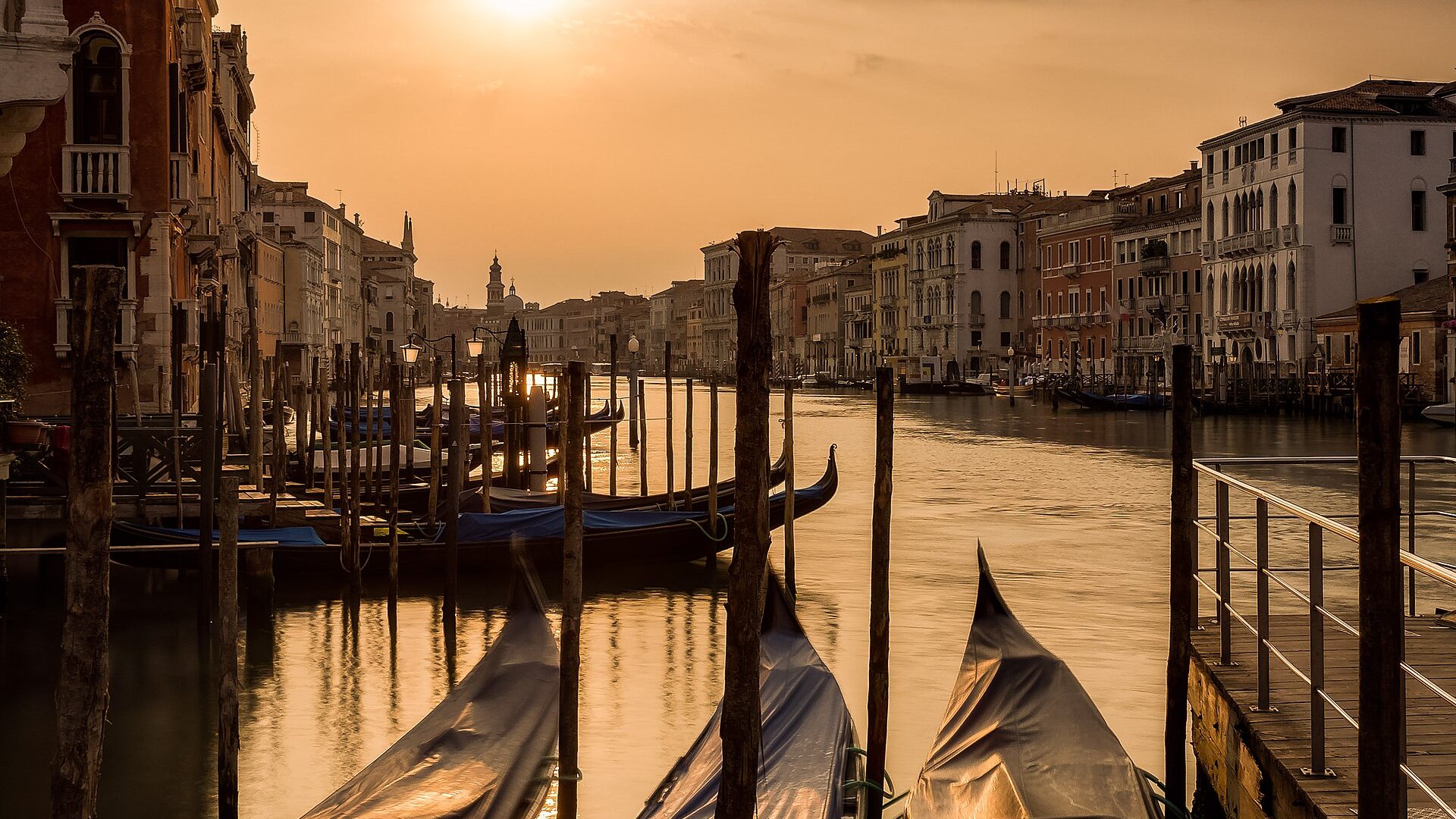
- A vaporetto down the Grand Canal on line 1, which stops everywhere and shows you the palace façades from the water they were designed to be seen from.
- The Accademia and the Peggy Guggenheim Collection, five minutes apart, covering Venetian painting to the fifteenth century and European modernism respectively.
- Torcello. The lagoon's oldest settlement, now almost empty, with a cathedral holding extraordinary Byzantine mosaics.
- A traghetto crossing. Standing gondolas ferry locals across the Grand Canal at several points for a small fare. The cheapest gondola ride there is.
Map
Map data © OpenStreetMap contributors
Best Time to Visit
April–June and September–October avoid both summer crowds/heat and the acqua alta flooding season (autumn–winter).
Where to Stay
Stay on the islands, not on the mainland. Mestre is markedly cheaper and it is a different trip: you miss the early mornings and the evenings, which are the best hours Venice has.
Dorsoduro and Cannaregio offer the best combination of atmosphere, food and price. Castello east of the Arsenale is quieter and cheaper again. San Marco is convenient for the monuments and expensive for everything else. Giudecca trades a vaporetto ride for lower rates and a view.
Two practical checks before booking: how many bridges lie between the nearest vaporetto stop and the door, and whether there is a lift. Both matter more here than in any other city.
Neighborhoods
San Marco: the monuments, the crowds and the highest prices. Central, but the least like living in Venice.
Dorsoduro: the Accademia, the Guggenheim, the university and Campo Santa Margherita. The best balance of atmosphere and access, and where many visitors wish they had stayed.
Cannaregio: the northern district, including the Jewish Ghetto, the first in Europe. Residential, good for eating, genuinely quiet at night.
Castello: the largest sestiere, stretching east past the Arsenale to the Biennale gardens. The further east you go, the more ordinary and the better value.
San Polo and Santa Croce: the Rialto market, the Frari, San Rocco. Central without being San Marco.
Giudecca: across the water, a short vaporetto ride, cheaper, with the best view back at the city.
Transportation & Airports
Walking is the primary transport. Venice is small, roughly 3 km end to end, and almost everywhere is reachable on foot. Expect bridges with steps, constantly.
Vaporetti are the public water buses run by ACTV. Single tickets are expensive; if you will make more than about three trips, a time-based travel card pays for itself quickly. Line 1 runs the length of the Grand Canal, line 2 is faster with fewer stops, and separate lines serve Murano, Burano and Torcello.
Traghetti cross the Grand Canal at points far from a bridge, for a fraction of a gondola fare.
Water taxis are fast, comfortable and very expensive. They make sense for arrival with luggage and rarely otherwise.
Gondolas are an experience, not transport. Rates are set by the city and vary by time of day; agree the route and duration before boarding.
Luggage is the hidden difficulty. There are no cars, so you carry bags over bridges. Pack accordingly, and check how far your accommodation is from a vaporetto stop.
Food
Venetian cooking is lagoon food: sarde in saor (sardines with onions, pine nuts and raisins), baccalà mantecato (whipped salt cod), risotto di gò made with lagoon goby, fegato alla veneziana, and black cuttlefish-ink risotto or pasta.
The institution to understand is the bacaro: a small wine bar serving cicchetti, single-bite snacks taken standing with a small glass of wine called an ombra. Moving between two or three bacari is how Venetians eat in the evening and is both cheaper and better than most sit-down meals near the monuments.
The reliable rule for avoiding bad food: walk away from San Marco and the Rialto bridge, avoid anywhere with a multilingual photo menu and a person outside inviting you in, and eat where the menu is short and seasonal.
Day Trips
Murano, Burano and Torcello. The classic lagoon circuit by vaporetto: glassmaking, painted fishermen's houses and Byzantine mosaics respectively. A full day if you do all three; Torcello is the one most people skip and the one with the most history.
Padua. Half an hour by train, for Giotto's Scrovegni Chapel (booked in advance, timed entry) and one of Europe's oldest universities.
Verona. About ninety minutes, for the Roman arena and a compact, walkable centre.
The Brenta Riviera. Venetian villas along the canal between Venice and Padua, reachable by boat excursion or bus.
Lido. Twenty minutes by vaporetto, and the lagoon's beach: useful in summer, and it has roads and cars, which is a strange sensation after a few days.
Budget
Venice is expensive, and the premium is concentrated in accommodation on the islands and in restaurants near the monuments. Everything else is manageable.
The effective levers: a multi-day vaporetto pass rather than singles; eating cicchetti in bacari rather than sit-down dinners in San Marco; standing at the bar for coffee; staying in Castello, Cannaregio or Giudecca rather than San Marco; and travelling outside the summer peak. Churches and the smaller scuole charge modest entry, and walking, the main activity, is free.
Travel Tips
The access fee is not currently in force. Venice trialled a day-visitor access charge, but the city's official access-fee service states that the 2026 trial period ended and that from 27 July the access fee is no longer in effect, and it is possible to visit Venice without any payment or request for exemption. A great deal of travel content still says otherwise. Check the Comune di Venezia access-fee site before you travel, since the position may change again.
Book San Marco and the Doge's Palace in advance. Timed entry removes the longest queues in the city.
Acqua alta: tidal flooding: is most likely between autumn and early spring. The city posts forecasts and sets out raised walkways; rubber boots are sold everywhere. It is an inconvenience, not a reason to cancel.
Sit-down charges. Cafés on the main squares charge substantially more for table service, sometimes with a music surcharge. This is disclosed and legal; standing at the bar costs a fraction.
Drink from the fountains. Public drinking fountains across the city run potable water. Carry a bottle.
Do not feed the pigeons in Piazza San Marco. It is prohibited and fined.
Day-tripper flow is predictable. Crowds concentrate between roughly 10:00 and 17:00 along the Rialto-to-San Marco axis. Plan monuments early, districts in the middle of the day.
Other Cities in Italy

Frequently Asked Questions
Do I have to pay an entry fee to visit Venice?
Not at present. The city's official access-fee service states that the 2026 trial ended and that from 27 July the access fee is no longer in effect, with no payment or exemption request needed. Check the Comune di Venezia site before travelling, as this has changed before.
Should I stay in Venice or in Mestre?
On the islands if you can. Mestre is cheaper but you lose early mornings and evenings, which are the best times in the city.
How many days do I need?
Two full days covers the main sights without rushing. Three lets you add the lagoon islands. Many visitors give it a single day trip and see only the most crowded parts.
Are gondolas worth it?
As an experience, for some people. Rates are set by the city and vary by time of day. For crossing the Grand Canal cheaply, use a traghetto instead.
What is acqua alta and should I worry?
Tidal flooding, most likely from autumn to early spring. The city forecasts it and puts out raised walkways. It is an inconvenience rather than a reason to change plans.
How do I get from the airport?
Marco Polo connects by bus to Piazzale Roma, or by Alilaguna water bus and private water taxi directly to the islands. Treviso airport is further out and served by coach.
Is Venice manageable with heavy luggage?
It is hard work. There are no cars, and you carry bags over stepped bridges. Check how far your accommodation is from a vaporetto stop before booking.
Plan your trip to Venice
Free tools for flight times, time differences, budget, money and plugs.
- Flight Duration CalculatorWork out real flight time across time zones.
- Time Zone ConverterFind the time in another city instantly.
- Trip Budget CalculatorEstimate your total trip cost, item by item.
- Currency ConverterConvert prices between currencies at indicative rates.
- Travel Plug & Voltage CheckerCheck if you need a plug adapter or voltage converter.
- Jet Lag CalculatorEstimate how many days you need to beat jet lag.