Prague
Overview
Prague survived the twentieth century almost intact. It was not carpet-bombed, and it was not comprehensively rebuilt afterwards, which is why a thousand years of architecture (Romanesque cellars, Gothic towers, Baroque churches, Art Nouveau facades and Cubist buildings found nowhere else) still stand in their original street plan.
The city is organised around a bend in the Vltava: the castle and Lesser Town on the western bank, the Old Town and New Town on the eastern, linked by the Charles Bridge and a dozen others. The historic core is a UNESCO World Heritage site and is small enough to cross on foot in under an hour.
Why Visit
Prague offers a complete, walkable historic city without the reconstruction that most of central Europe required, and at prices still below the western European capitals.
It also carries a layered history that is unusually legible on the ground: the Jewish Quarter with six surviving synagogues, the Baroque of the Counter-Reformation, the Communist decades, and the Velvet Revolution that ended them, all within the same few square kilometres.
Best Things to Do
- Prague Castle. Described as the largest ancient castle complex in the world, and more a walled district than a building: St Vitus Cathedral, the Old Royal Palace, St George's Basilica and the Golden Lane. The grounds are open freely; the buildings are ticketed.
- Charles Bridge at dawn. The fourteenth-century bridge with its Baroque statues is impassably crowded from mid-morning. At sunrise it is nearly empty and the mist comes off the river.
- The Jewish Quarter (Josefov). The Old-New Synagogue, in continuous use since the thirteenth century, the Spanish Synagogue's interior, and the Old Jewish Cemetery with its layered headstones. The Jewish Museum sells a combined ticket covering most of the sites.
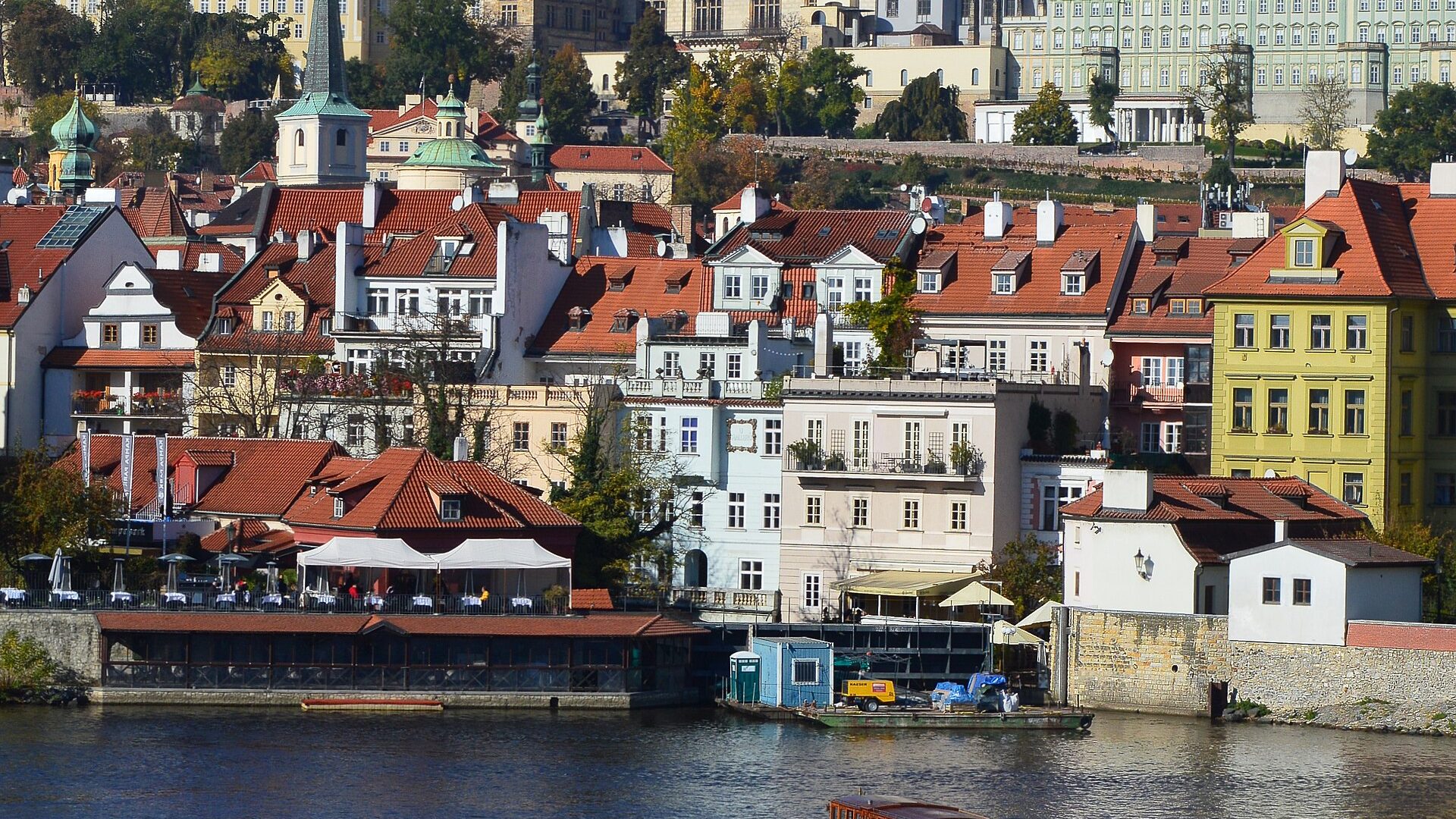
- Petřín Hill. A funicular up to gardens, an observation tower and the best panorama over the red roofs; the walk down through the orchards is the pleasant way to return.
- Vyšehrad. The second castle, on a rock south of the centre: a neo-Gothic church, ramparts to walk, a cemetery of Czech composers and writers, and almost no crowds.
- The Municipal House. Art Nouveau at full volume, with a concert hall by Alfons Mucha and others; visit on a tour or at a concert.
- A neighbourhood beer hall. Czech beer culture is a serious, everyday institution; the interesting pubs are in Vinohrady, Žižkov and Karlín rather than around the Old Town Square.
Map
Map data © OpenStreetMap contributors
Best Time to Visit
May, June and September are the best months: warm, long days, and gardens open. April and October are cooler and cheaper with good light.
July and August are hot and extremely crowded in the historic core. December brings the Christmas markets on the Old Town and Wenceslas squares, which are genuinely atmospheric and also the most expensive weeks of the winter.
January to March is cold, often grey, sometimes snowy, and the quietest and cheapest time to come, which for a city this crowded is a serious argument in its favour.
Where to Stay
Old Town (Staré Město) is the most convenient and the most touristed, with prices and night noise to match.
Lesser Town (Malá Strana) sits below the castle: Baroque palaces, gardens and quiet lanes, beautiful and a climb.
New Town (Nové Město) around Wenceslas Square is central and cheaper, with a mixed character.
Vinohrady is the best all-round choice for value and atmosphere: leafy residential streets, good restaurants, ten minutes by metro from the centre. Žižkov next door is cheaper and famous for its density of pubs. Karlín is a rebuilt riverside district with new restaurants and easy transport.
Neighborhoods
Staré Město: the Old Town Square, the astronomical clock, Týn Church and the lanes between them.
Josefov: the former Jewish ghetto, with the synagogues and cemetery, now also the luxury shopping street.
Malá Strana: Baroque palaces, walled gardens, the Lennon Wall and the approach to the castle.
Hradčany: the castle district itself, plus the Strahov and Loreta monasteries.
Nové Město: Wenceslas Square, the National Museum, the dancing house on the river, and the Cubist architecture around Vyšehrad.
Vinohrady: Art Nouveau apartment blocks, parks, and the best neighbourhood eating.
Žižkov: working-class history, the television tower, and a very high pub-to-resident ratio.
Holešovice: an industrial district turned over to contemporary art, markets and the city's largest park at Stromovka.
Transportation & Airports
The metro, trams and buses run on one ticket system priced by duration rather than distance. Paper tickets must be validated in the yellow machine when you first board or enter the metro; inspectors check regularly and fine on the spot.
Trams are the pleasure of the system, line 22 runs past the castle and through Malá Strana and is effectively a sightseeing route on a normal fare. Night trams and buses run when the metro closes.
The historic centre is walkable end to end, and much of it is cobbled and hilly around the castle.
The airport is not on the metro; buses connect it to metro stations, and airport express services run to the main railway station. Use registered taxis or an app rather than hailing on the street, where overcharging of visitors has a long history.
Food
Czech cooking is built for the climate: roast pork with dumplings and sauerkraut, beef in cream sauce with bread dumplings and cranberry, goulash, and soups served in bread. Portions are generous and the dumplings are the point rather than a side.
Beer is central. The Czech Republic has one of the highest per-capita beer consumptions in the world, and the pilsner style was created in Plzeň in 1842. In a traditional pub you sit where there is room, the beer arrives without much asking, and a mark is made on a slip of paper at your table which is totalled when you leave.
Two practical notes: the trdelník sold as an ancient Czech pastry in the old town is neither ancient nor Czech, and food or drink accepted from a tout on the street is where most visitor overcharging happens. Tipping is by rounding up, around five to ten per cent.
Day Trips
Kutná Hora: a silver-mining town whose wealth built St Barbara's Cathedral, plus the Sedlec ossuary decorated with human bones. An hour by train and the most rewarding trip from Prague.
Terezín: the fortress town used by the Nazis as a ghetto and transit camp, now a memorial. About an hour north; sobering and important.
Český Krumlov: a small Baroque town in a river loop in southern Bohemia, World Heritage listed; three hours away, so better as an overnight than a day trip.
Karlštejn: a Gothic castle built to hold the crown jewels, forty minutes by train and a walk through the woods.
Bohemian Switzerland: sandstone gorges and rock arches on the German border, about two hours north.
Budget
Prague is good value by western European standards, though the very centre is priced for visitors. Beer, public transport and everyday restaurant meals are inexpensive; accommodation in the historic core is where the money goes.
Free or near-free: the castle grounds and gardens, walking the bridges, Vyšehrad's ramparts, Petřín's park, and most churches outside the ticketed ones. The paid highlights are the castle buildings, the Jewish Museum circuit and the Municipal House.
The reliable saving is to eat and drink one tram stop away from the Old Town Square. The same meal in Vinohrady or Žižkov often costs half. Avoid currency exchange booths in the tourist streets, which are where visitors lose the most money in this city. Use a bank ATM and decline the machine's own conversion offer.
Travel Tips
Validate your ticket in the yellow box before travelling. Inspectors are frequent and unsympathetic.
Decline dynamic currency conversion. When an ATM or card terminal offers to charge you in your home currency, choose Czech koruna instead. The alternative applies a poor rate.
Avoid street exchange booths. Advertised rates often exclude heavy commission. Banks and ATMs are the safe option.
Go to Charles Bridge and the astronomical clock early. By ten in the morning both are shoulder to shoulder.
Do not accept an invitation from a street tout to a bar or club; inflated bills are a long-established problem around Wenceslas Square.
Wear proper shoes. The cobblestones and the climb to the castle are harder on the feet than the map suggests.
Frequently Asked Questions
How many days do I need in Prague
Two full days covers the castle, the Old Town and the Jewish Quarter. Three or four lets you add Vyšehrad, a residential neighbourhood and a day trip to Kutná Hora or Terezín.
Do I need to buy a ticket for Prague Castle
Not to walk through the grounds and courtyards, which are open. The interiors (St Vitus, the Old Royal Palace, the basilica and Golden Lane) are covered by a circuit ticket.
What currency is used
The Czech koruna, not the euro. Some places accept euros at an unfavourable rate, so pay in koruna and take cash from a bank ATM rather than an exchange booth.
Is Prague crowded
The historic core is, from mid-morning until evening, most of the year. The fix is timing rather than avoidance: early mornings, late evenings, and basing yourself in Vinohrady or Karlín where the crowds do not reach.
Is the trdelník a traditional Czech pastry
No, despite how it is sold in the old town. It is a recent tourist product with roots elsewhere in central Europe. For local sweets, look for koláče or a bakery outside the tourist streets.
Plan your trip to Prague
Free tools for flight times, time differences, budget, money and plugs.
- Flight Duration CalculatorWork out real flight time across time zones.
- Time Zone ConverterFind the time in another city instantly.
- Trip Budget CalculatorEstimate your total trip cost, item by item.
- Currency ConverterConvert prices between currencies at indicative rates.
- Travel Plug & Voltage CheckerCheck if you need a plug adapter or voltage converter.
- Jet Lag CalculatorEstimate how many days you need to beat jet lag.