Barcelona
Overview
Barcelona has two street plans and they explain the city. The Ciutat Vella is medieval: narrow, dark, unplanned. Beyond it, the Eixample is a nineteenth-century grid of octagonal blocks with chamfered corners, designed by Ildefons Cerdà to let light and air into a city that had just demolished its walls. Almost all the Modernista architecture people come to see stands in that grid.
Between the hills of Collserola and the sea, the city is compact, flat in the middle, and organised so that you can walk from a Roman wall to a beach in under an hour.
Why Visit
Barcelona offers a concentration of Modernista architecture that exists nowhere else (Gaudí, Domènech i Montaner and Puig i Cadafalch, much of it inscribed by UNESCO) in a Mediterranean city with beaches inside the municipal boundary.
It is also Catalan rather than generically Spanish: a separate language, its own festivals and food traditions, and an identity that the city is proud of and that visitors are expected to notice.
Best Things to Do
- The Sagrada Família. Still under construction after more than a century. Book a timed ticket well ahead; the interior forest of columns in late-afternoon light is the reason to go, and the tower climbs are booked separately.
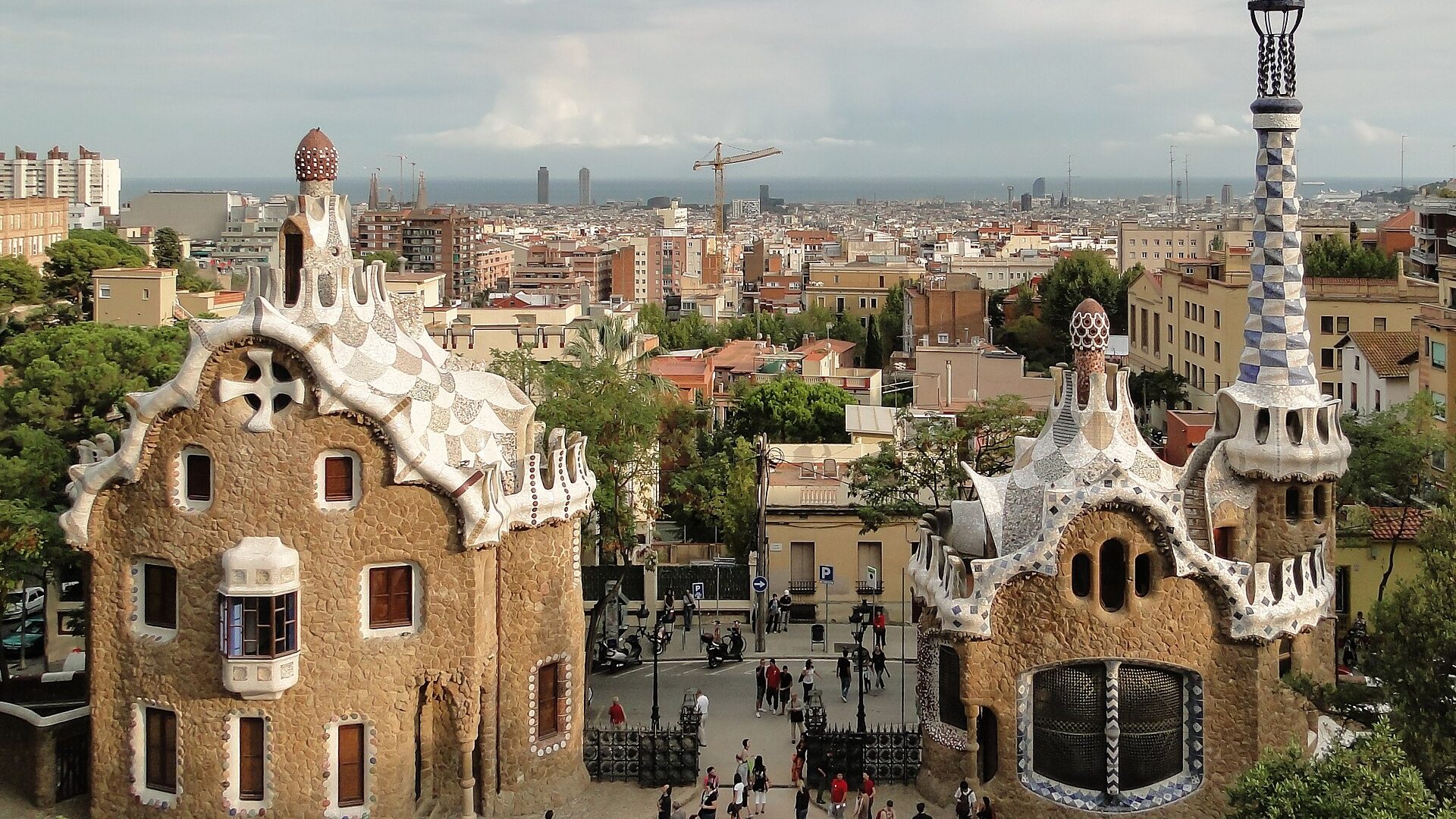
- Park Güell. The Monumental Zone (terrace, mosaic bench and gatehouses) is ticketed with timed entry; the surrounding park is free and gives you the view without the queue.
- Casa Batlló and La Pedrera. Two Gaudí apartment buildings on Passeig de Gràcia, both visitable inside. If you only do one, La Pedrera's roof terrace is the more extraordinary space.
- The Gothic Quarter and the Roman wall. Barcelona began as Barcino, and sections of the wall and the underground city are visible at the Museu d'Història.
- Santa Maria del Mar. Catalan Gothic at its purest, built by the parish itself in the fourteenth century; free to enter outside services and a complete contrast to Gaudí.
- Montjuïc. The castle, the Joan Miró Foundation, the Olympic ring and the MNAC's Romanesque frescoes, with a cable car and funicular to get up there.
- The Palau de la Música Catalana. A Modernista concert hall of stained glass and sculpture; visit on a guided tour or, better, at a concert.
Map
Map data © OpenStreetMap contributors
Best Time to Visit
May, June, September and early October are the best months: warm, swimmable, and without the August crush.
July and August are hot, humid and at maximum capacity, and many local businesses close for part of August. Winter is mild, often sunny, and much cheaper, with the major sites quiet: a genuinely good time for an architecture-focused trip, if not a beach one.
Two dates worth planning around or avoiding, depending on taste: La Mercè in late September, the city's main festival with human towers and fire runs, and Sant Joan on the night of 23 June, which is spent on the beach with fireworks.
Where to Stay
Eixample is the practical choice: wide streets, good metro, the Modernista buildings on the doorstep, and calmer nights than the old city.
Gràcia was a separate town until the 1890s and still feels like one: small squares, independent shops, local restaurants, a short metro ride from the centre.
El Born is atmospheric and central, good for restaurants and bars. The Gothic Quarter is the most touristed and the noisiest. Barceloneta puts you on the beach in a dense former fishing quarter.
Avoid the lower Rambla if you want to sleep. Note that Barcelona regulates tourist apartments tightly; book licensed accommodation, which matters legally as well as ethically in a city where housing pressure is a live political issue.
Neighborhoods
Barri Gòtic: the medieval core, the cathedral, Roman remains, and the densest crowds.
El Born and La Ribera: Santa Maria del Mar, the Picasso Museum, and streets of small bars and design shops.
El Raval: the most mixed quarter, with the contemporary art museum, a strong migrant food scene, and a rougher edge in parts.
Eixample: the grid, split into the elegant Dreta with the Modernista houses and the Esquerra, which includes the Gaixample nightlife district.
Gràcia: village squares, independent cinemas and the August street festival where residents decorate whole blocks.
Barceloneta and Poblenou: the beaches; Poblenou is the former industrial quarter, now a tech district with a calmer seafront.
Sant Andreu and Sants: residential Barcelona, useful to see if you want the city without the visitors.
Transportation & Airports
The metro is clean, frequent and covers everything most visitors need; a multi-journey ticket shared between travellers is normally better value than singles or a tourist card. Buses fill in the diagonal routes the metro misses, and the funicular and cable cars reach Montjuïc and Tibidabo.
The city is unusually good for walking and for cycling, with a dense network of bike lanes and the superblock schemes that have closed some streets to through traffic.
From the airport: the Aerobús is the fastest link to Plaça Catalunya, the metro line is cheaper, and the suburban train serves one terminal. All three beat a taxi in traffic.
Pickpocketing on the metro, on the Rambla and around the Sagrada Família is the city's one persistent problem. Bags in front, phones away on crowded platforms.
Food
Catalan food is not tapas, though tapas are everywhere. The local repertoire is pa amb tomàquet, escalivada, botifarra, fideuà, calçots in late winter and a strong seafood tradition, and the sweet is crema catalana, not flan.
Eating times are late: lunch from around two, dinner rarely before nine. The menú del dia at lunch on weekdays is the best-value meal in the city by a wide margin: several courses, bread and a drink at a fixed price.
La Boqueria is worth walking through but is now expensive at the front; the markets of Santa Caterina and Sant Antoni are where people actually shop. Vermouth before lunch at the weekend is a genuine local ritual and an easy one to join.
Day Trips
Montserrat: the serrated mountain and its Benedictine monastery, reached by train and then rack railway or cable car. Hiking trails run along the ridge above the basilica.
Girona: a walled city with a colour-washed riverfront, a large Jewish quarter and one of the widest Gothic naves in Europe; under forty minutes on the high-speed train.
Sitges: beaches, a seafront church and a relaxed gay-friendly resort town, half an hour south by local train.
Tarragona: Roman amphitheatre, circus and aqueduct on the coast, an hour away.
Penedès: the cava vineyards inland, reachable by train to Sant Sadurní d'Anoia and visitable at the producers.
Budget
Barcelona is mid-priced for western Europe, but the ticketed Gaudí sites add up quickly and are the main cost after the hotel. The beaches, the parks, the Gothic Quarter, Santa Maria del Mar and the free part of Park Güell cost nothing.
The strongest saving is the weekday menú del dia at lunch, followed by eating and drinking away from the Rambla. A multi-journey metro ticket beats a tourist travel card unless you are riding constantly. Some municipal museums offer free admission at certain times: check the current schedule on each museum's own site, as it changes.
Travel Tips
Book Sagrada Família, Casa Batlló and Park Güell ahead. All three use timed entry and sell out in season.
Learn that Catalan is the local language. Signage is often in Catalan first; Spanish is universally understood, and a greeting in Catalan is noticed and appreciated.
Guard your belongings on the Rambla, in the metro and at the beach. This is the one thing almost every visitor is warned about, and the warning is accurate.
Eat on local time or you will find kitchens closed. Between roughly four and eight, most restaurants serve only drinks.
Do not walk around the city in swimwear. It is fined in Barcelona outside the beach area.
Check whether your accommodation is licensed. Unlicensed tourist flats are illegal here and can be cancelled at short notice.
Other Cities in Spain
Frequently Asked Questions
How many days should I spend in Barcelona
Three full days covers the main Gaudí sites, the Gothic Quarter and a beach afternoon. Four or five adds Montjuïc, Gràcia and a day trip to Montserrat or Girona without rushing.
Do I need to book the Sagrada Família in advance
Yes. It uses timed entry and regularly sells out days ahead in high season. The tower climbs are a separate booking made at the same time.
Is Park Güell free
Partly. The wider park is free to walk in; the Monumental Zone with the mosaic terrace and the gatehouses is ticketed with timed entry and needs booking.
What language do people speak
Catalan and Spanish are both official, and most residents use both. Visitors manage entirely in Spanish, and English is widely spoken in tourism, but Catalan is the language of the city itself.
Are the beaches any good
They are city beaches, clean, supervised, and busy in summer. For quieter sand, take the local train up the coast to the Maresme towns or south to Sitges.
Plan your trip to Barcelona
Free tools for flight times, time differences, budget, money and plugs.
- Flight Duration CalculatorWork out real flight time across time zones.
- Time Zone ConverterFind the time in another city instantly.
- Trip Budget CalculatorEstimate your total trip cost, item by item.
- Currency ConverterConvert prices between currencies at indicative rates.
- Travel Plug & Voltage CheckerCheck if you need a plug adapter or voltage converter.
- Jet Lag CalculatorEstimate how many days you need to beat jet lag.