Seoul
Overview
South Korea's capital, a city of roughly ten million in a metropolitan area of about 26 million, built along the Han River with mountains inside the city limits. It runs on one of the world's densest and most efficient metro systems, and almost everything a visitor needs is reachable on it.
Seoul's defining quality is compression: 600-year-old palaces, hanok alleys, department stores, and neighbourhoods that reinvent themselves every few years, all within a few metro stops of each other.
Why Visit
The palaces are the historic core. Changdeokgung, inscribed by UNESCO in 1997, was built in the early 15th century on a site chosen by geomantic principles, and is distinguished from conventional palace architecture by how it adapts to uneven terrain rather than flattening it. Its rear garden, the Biwon or Secret Garden, holds terraces, lotus pools and pavilions among more than 56,000 trees and plants, and is visited on a timed guided tour.
The other reason is contemporary: food, design, cafés, music and nightlife that change fast enough that returning visitors find a different city. Seoul is also unusually easy: safe, signposted in English on transit, and cheap to move around.
Best Things to Do
- Changdeokgung and the Secret Garden. Book the garden tour; it is separate from palace admission and capacity-limited. Go early.
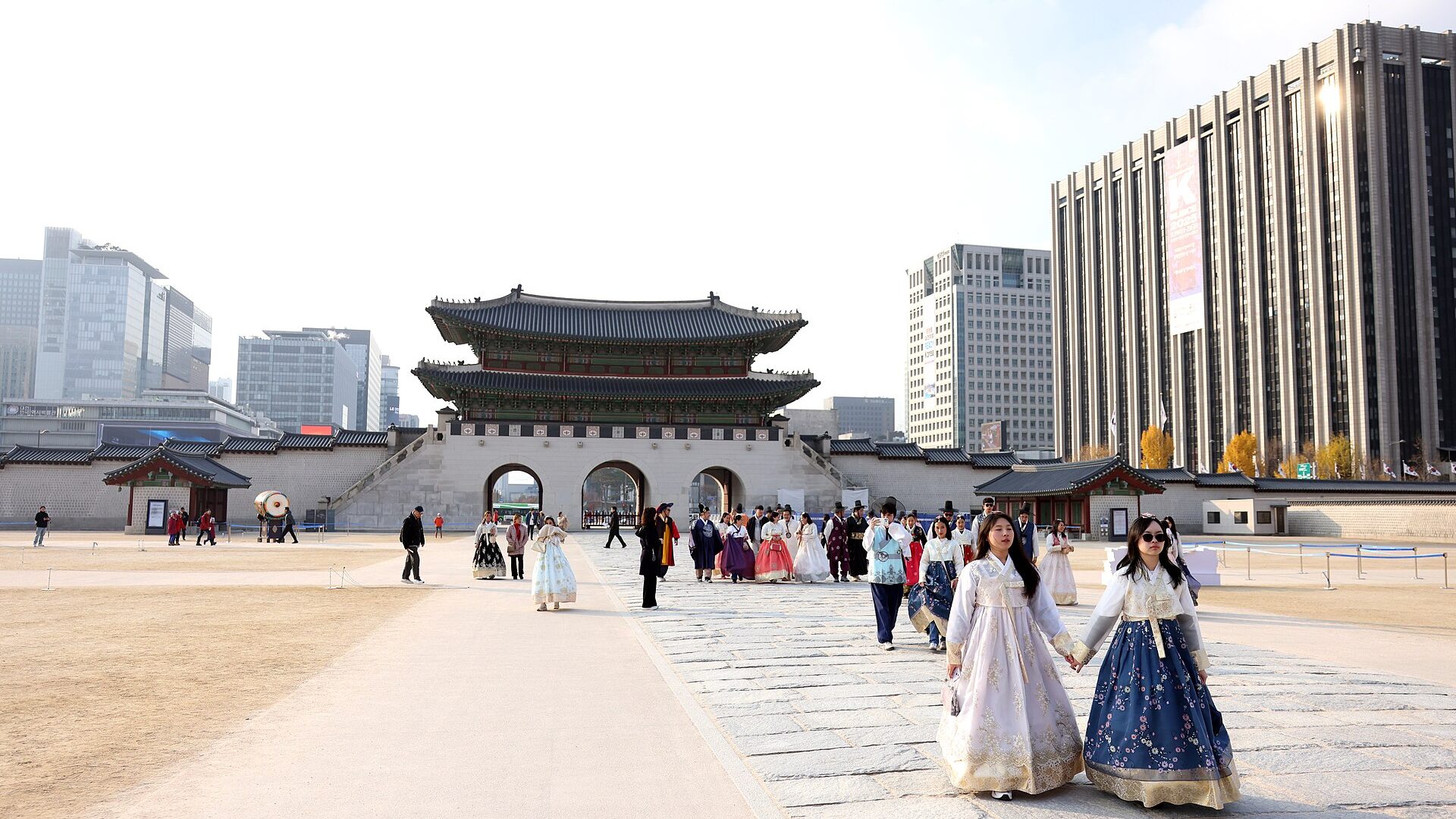
- Gyeongbokgung, the largest palace, with the changing of the guard. Renting a hanbok gets you in free and is genuinely common among Korean visitors, not only tourists.
- Bukchon Hanok Village. A residential district of traditional houses between the two palaces. People live here: signs ask for quiet, and they mean it.
- Gwangjang Market for street food — bindaetteok, mayak gimbap, raw beef tartare — eaten standing at a stall counter.
- A night view from Namsan or Bukak Skyway. The N Seoul Tower is reachable by cable car; the walk up through Namsan park is pleasant in itself.
- Jjimjilbang. A Korean bathhouse and sauna complex, open late, cheap, and a genuine local institution rather than a tourist activity.
- A neighbourhood evening in Euljiro, Seongsu or Yeonnam-dong, where the current food and bar scene actually is.
- The DMZ, reachable on an organised day tour: the only way to go, since independent access is not permitted.
Map
Map data © OpenStreetMap contributors
Best Time to Visit
April–June and September–November for mild weather and seasonal color.
Where to Stay
Jongno, Insadong or Myeongdong for a first visit: central, on multiple metro lines, walking distance to the palaces.
Hongdae for nightlife and budget accommodation, accepting noise. Itaewon or Hannam for international food and a more relaxed evening scene. Gangnam for business travel and upmarket hotels, at the cost of atmosphere.
Seongsu or Seongbuk for a residential feel with good cafés. Anywhere within a few minutes' walk of a metro station works in Seoul — the network matters more than the district.
Neighborhoods
Jongno and Insadong: palaces, hanok lanes, tea houses and traditional crafts. The historic centre and the most convenient base for first visits.
Myeongdong: cosmetics, street food and shopping, extremely busy, central and well connected.
Hongdae: university district: live music, cheap food, late nights, young crowd.
Itaewon and Hannam: the most international quarter, with a wide range of foreign restaurants and the Leeum museum nearby.
Gangnam: south of the river: business, high-end retail, wide avenues, less walkable and less atmospheric than the north.
Seongsu: a former industrial area now full of cafés, concept stores and galleries. The current answer to "where is Seoul happening".
Euljiro: printing workshops by day, small bars hidden in the same buildings by night.
Transportation & Airports
Buy a T-money card at any convenience store or station machine and load it with cash. It covers the metro, buses and taxis, gives a small discount over single tickets, and handles the transfer discounts automatically. This is the first thing to do on arrival.
The metro is extensive, signed in English and Korean, announces stops in English, and is the fastest way across the city. Trains stop running around midnight: check the last train if you are out late, because the night bus network is harder to navigate.
Buses fill the gaps; colour-coded by route type and best used with a mapping app.
Taxis are plentiful and inexpensive by international standards. Kakao T is the local hailing app; international ride-hailing apps have limited coverage.
From the airport: Incheon connects by AREX train — an express to Seoul Station and a slower all-stops service — and by limousine buses that run directly to hotel districts and are easier with luggage. Gimpo, closer in, handles domestic and some regional flights.
Note on mapping: Google Maps has limited walking and driving directions in South Korea for legal reasons. Naver Map or KakaoMap work properly; download one before arriving.
Food
Korean food in Seoul spans the very cheap to the very refined, and both are worth doing. Korean barbecue: samgyeopsal, galbi — is cooked at the table and is a group activity. Stews like kimchi jjigae and sundubu jjigae are the everyday staples. Street food runs from tteokbokki and hotteok to the market specialities at Gwangjang and Tongin.
Two things to know. Side dishes, banchan, arrive free with meals and are refilled on request. And many restaurants specialise in a single dish: the menu may hold three items, which is a sign of quality rather than limitation.
Seoul's café culture is extraordinary in scale and design ambition, particularly in Seongsu and Yeonnam-dong. Convenience stores are a genuine food option late at night, and locals use them that way.
Day Trips
The DMZ. Half or full day, by organised tour only — independent visits are not permitted. Bring your passport; itineraries vary and can be cancelled at short notice for operational reasons.
Suwon. An hour by metro, for Hwaseong Fortress, a late-18th-century walled circuit you can walk in full.
Incheon. Korea's largest Chinatown and the Open Port area, plus ferries to nearby islands.
Nami Island and Chuncheon, about 90 minutes by ITX train, for the tree-lined island and Chuncheon's dakgalbi.
Gyeongju is further — roughly two hours by KTX — and is really an overnight rather than a day trip, but it is Korea's densest concentration of ancient sites.
Budget
Seoul is moderately priced for a major Asian capital. Transport is cheap, street and market food is very cheap, and mid-range restaurants are reasonable. Accommodation is the main variable, and it rises sharply in the central districts during peak seasons.
Cost savers that work: eat at markets and single-dish restaurants, use the metro with a T-money card rather than taxis, visit palaces on a combined ticket, and take advantage of the many free viewpoints and parks. Hanbok rental paying for palace entry is a genuine saving as well as an experience.
Travel Tips
Get a T-money card first, and download Naver Map or KakaoMap. Google Maps will not give you reliable directions here.
Book the Changdeokgung Secret Garden tour in advance: it is capacity-limited and separate from general palace admission.
Palaces close one day a week, usually Monday or Tuesday depending on the palace. Check before planning a palace day.
Metro stops around midnight. Know your last train, or plan to take a taxi.
Tipping is not practised and can cause confusion. Do not tip.
Cards are accepted almost everywhere, including small stalls, but carry some cash for traditional markets.
Free wifi is widespread; a transit card, a mapping app and a translation app cover most practical needs.
Seasons are extreme. Summer is hot, humid and includes a monsoon period; winter is cold and dry. Spring and autumn are short and are the best times to visit.
Frequently Asked Questions
What is a T-money card and do I need one?
A rechargeable transit card sold at convenience stores and station machines. It covers metro, buses and taxis with automatic transfer discounts. Get one on arrival.
Why doesn't Google Maps work properly?
South Korea restricts export of detailed mapping data, so Google Maps gives limited walking and driving directions. Use Naver Map or KakaoMap instead.
When is the best time to visit?
Spring (April to May) and autumn (September to November) are mild and are the best seasons. Summer is hot, humid and includes heavy monsoon rain; winter is very cold.
How do I visit the DMZ?
Only on an organised tour — independent access is not permitted. Take your passport, and expect that itineraries can change or be cancelled at short notice.
How many days do I need?
Four to five days covers the palaces, several neighbourhoods and a day trip. Seoul rewards longer stays because so much of it is neighbourhood-level rather than monument-level.
Do I tip?
No. Tipping is not part of Korean practice and is not expected anywhere.
Which palace should I prioritise?
Changdeokgung, for the UNESCO listing and the Secret Garden. Gyeongbokgung is larger and more ceremonial; both are close together.