Kraków
Overview
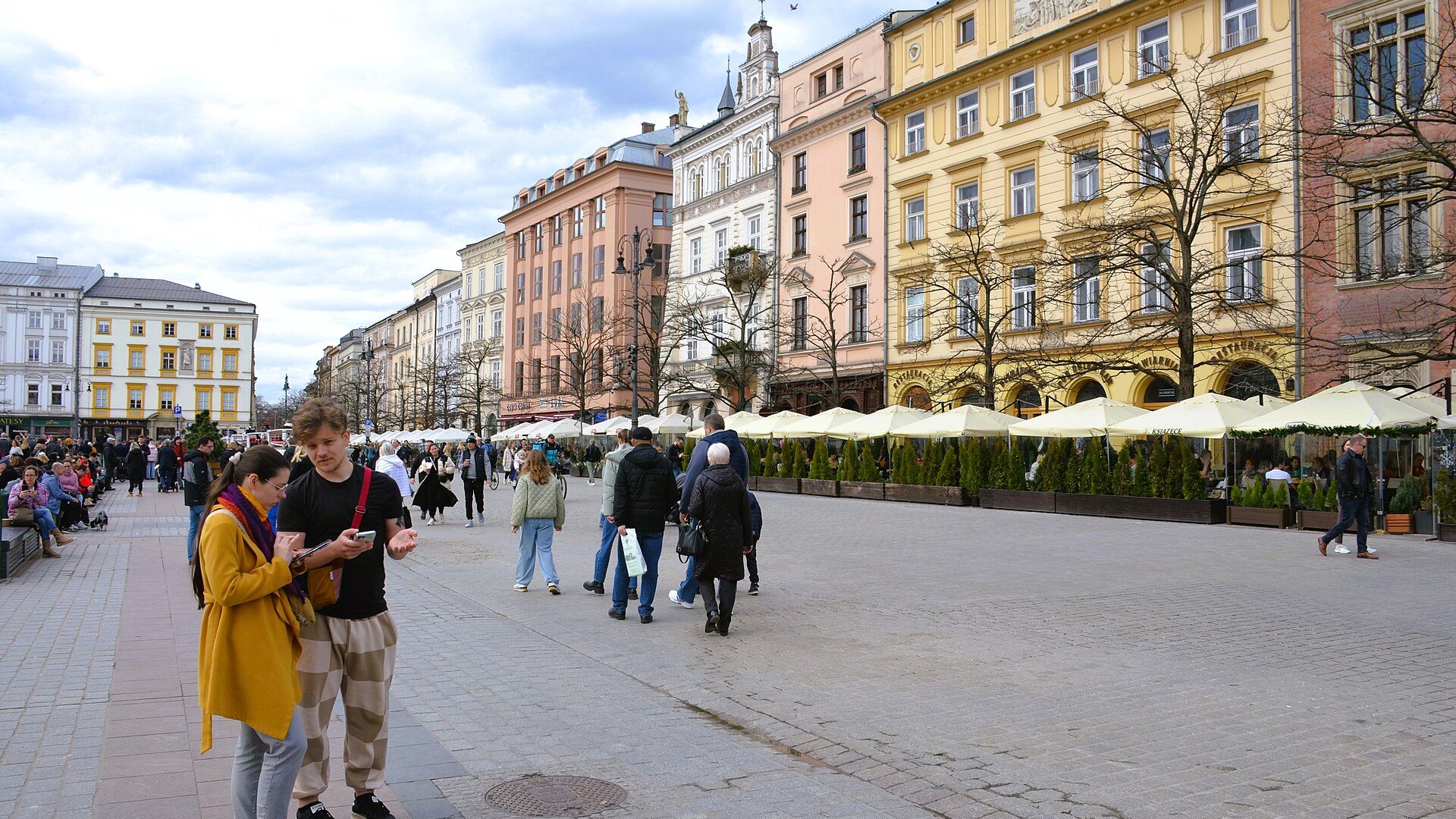
Kraków was Poland's royal capital for over five centuries, and the city still reads that way: a vast market square at the centre, a cathedral and castle on the limestone rise of Wawel above the Vistula, and a street plan that has barely moved since the Middle Ages. The Old Town survived the Second World War largely intact, which is unusual in Poland and the reason the historic centre was among the first sites inscribed on the UNESCO World Heritage List.
What makes the city work for travellers is scale. The Planty, a green ring that replaced the medieval walls, encircles a centre you can cross on foot in twenty minutes. Kazimierz, Podgórze and the castle are all within walking distance or a short tram ride, so a visit rarely involves planning transport at all.
Why Visit
Few European cities put this much history within this little distance. In one day you can stand in Europe's largest medieval market square, walk up to a royal cathedral, cross the river to the site of the wartime ghetto, and end the evening in a courtyard bar in Kazimierz.
Kraków is also a student city, with a university founded in the fourteenth century, so the historic setting is not a museum piece: the squares and cellars are busy year-round with people who live there.
Best Things to Do
- Rynek Główny, early or late. The main square is Europe's largest medieval market square, with the Cloth Hall down its middle. It is at its best before the day-trip coaches arrive or after dinner, when the arcades empty out.
- St Mary's Basilica and the hejnał. The Gothic church on the square holds Veit Stoss's carved wooden altarpiece. On the hour, a trumpet call is played from the taller tower and breaks off mid-phrase, a tradition the city has kept for centuries.
- Wawel Hill. The royal castle and cathedral sit on a rise above the Vistula. The cathedral, where Polish monarchs were crowned and buried, is the more affecting of the two.
- Kazimierz. The historic Jewish quarter, with several surviving synagogues and the old cemetery, now also the centre of the city's café and bar life.
- Podgórze and Schindler's Factory. Across the river, the former ghetto district, the memorial of empty chairs on Plac Bohaterów Getta, and the museum in Oskar Schindler's enamel factory.
- The Rynek Underground. An archaeological museum beneath the main square, built around the excavated medieval market level.
Map
Map data © OpenStreetMap contributors
Best Time to Visit
May, June and September are the most comfortable months: long daylight, mild temperatures and outdoor seating on every square without the full weight of high summer.
July and August are warm and busy, and the Old Town can feel crowded around the main sights in the middle of the day. Early mornings still belong to residents.
December brings the Christmas market to Rynek Główny and is atmospheric, but cold and dark by mid-afternoon. January and February are the quietest and cheapest months, with real winter weather.
Where to Stay
Old Town is the obvious first-visit base: everything is on foot, and the ring of parkland keeps traffic out. The trade-off is noise on the streets closest to the square at weekends.
Kazimierz suits travellers who want a shorter walk to the evening and a quieter morning, with the Old Town still ten to fifteen minutes away.
Podgórze, across the river, is residential and calm, and close to the wartime sites. Around the main station is convenient for early trains and day trips but has little character of its own.
Neighborhoods
Stare Miasto (Old Town): the walled medieval core inside the Planty ring, with the market square, the Cloth Hall, the university quarter and most of the churches.
Wawel: the castle and cathedral hill at the southern edge of the Old Town, above the river.
Kazimierz: the historic Jewish quarter, with synagogues, the old cemetery, Plac Nowy and the densest concentration of bars and cafés in the city.
Podgórze: across the Vistula, the site of the wartime ghetto, now a quiet residential district with the Schindler's Factory museum and contemporary art at MOCAK.
Nowa Huta: a planned socialist-realist district built east of the centre in the late 1940s, reachable by tram and quite unlike the rest of the city.
Transportation & Airports
The historic centre is closed to most traffic and is best covered on foot. For anything further, the tram network is dense, frequent and the way locals move; buses fill in the gaps.
Kraków Główny, the main railway station, sits immediately north-east of the Old Town and connects the city to Warsaw and the rest of Poland. The airport at Balice is linked to the same station by a direct train.
Taxis and ride-hailing apps both operate. Cycling is straightforward along the Vistula embankments, less so on the cobbles of the centre.
Food
Kraków eats well and cheaply. Pierogi are the obvious starting point, boiled or fried, savoury or sweet. Żurek, a sour rye soup, and bigos, a long-cooked cabbage and meat stew, are the cold-weather staples.
Two street foods are specific to the city: the obwarzanek, a ring of braided bread sold from carts, and the zapiekanka, an open baguette baked with mushrooms and cheese, associated with the round hall on Plac Nowy in Kazimierz.
Milk bars (bar mleczny) are subsidised canteens that survived from the communist period and still serve plain Polish cooking at low prices.
Day Trips
Auschwitz-Birkenau, at Oświęcim, is the most visited day trip from Kraków. Visits to the memorial and museum are organised and time-slotted; it is a long and demanding day rather than a stop on a wider itinerary.
Wieliczka Salt Mine, just outside the city, is a UNESCO site with chapels and chambers carved into rock salt across several underground levels. It is reachable in well under an hour.
Zakopane and the Tatra Mountains lie south towards the Slovak border and work better as an overnight than a day trip. Ojców National Park, north of the city, is a short, easy excursion into limestone valleys and castle ruins.
Budget
Kraków is inexpensive by Western European standards. Eating is where the difference shows most: milk bars, pierogi restaurants and street food keep daily food costs low, and a sit-down meal with a drink remains modest. Accommodation is the main variable, rising sharply on the main square and in high summer.
Trams and buses are cheap, and the walkable centre means many days need no transport at all. Museum and memorial entry is the other regular cost, with several of the major sites requiring timed tickets booked ahead.
Travel Tips
Book Auschwitz-Birkenau and Wieliczka ahead. Both use timed entry and both sell out in the busier months. Neither is a decision to leave until the morning of.
Give Kazimierz an evening of its own. Trying to fit it around a full Old Town day leaves it feeling like an afterthought.
The centre is cobbled. Wheeled luggage and thin soles both suffer; the walk from the station is short but rough.
Churches are working churches. Services run through the day, photography is often restricted, and modest dress is expected.
Card payment is near-universal, including on trams and in small cafés, though a little cash is useful at market stalls.
Frequently Asked Questions
How many days do I need in Kraków
Two full days cover the Old Town, Wawel and Kazimierz at a reasonable pace. Three or four let you add Auschwitz-Birkenau or Wieliczka without compressing everything else.
Is Kraków walkable
Yes. The Old Town, Wawel and Kazimierz form a continuous walk of a few kilometres, and the historic centre is largely closed to cars.
Should I visit Auschwitz-Birkenau from Kraków
It is the most common day trip and the memorial is set up for visitors arriving from the city. Plan a full day, book a time slot in advance, and do not schedule anything demanding for the evening.
Is Kraków a good winter destination
December has the Christmas market and a strong atmosphere, but the days are short and cold. January and February are quiet and cheap if you do not mind winter weather.
Plan your trip to Kraków
Free tools for flight times, time differences, budget, money and plugs.
- Flight Duration CalculatorWork out real flight time across time zones.
- Time Zone ConverterFind the time in another city instantly.
- Trip Budget CalculatorEstimate your total trip cost, item by item.
- Currency ConverterConvert prices between currencies at indicative rates.
- Travel Plug & Voltage CheckerCheck if you need a plug adapter or voltage converter.
- Jet Lag CalculatorEstimate how many days you need to beat jet lag.