
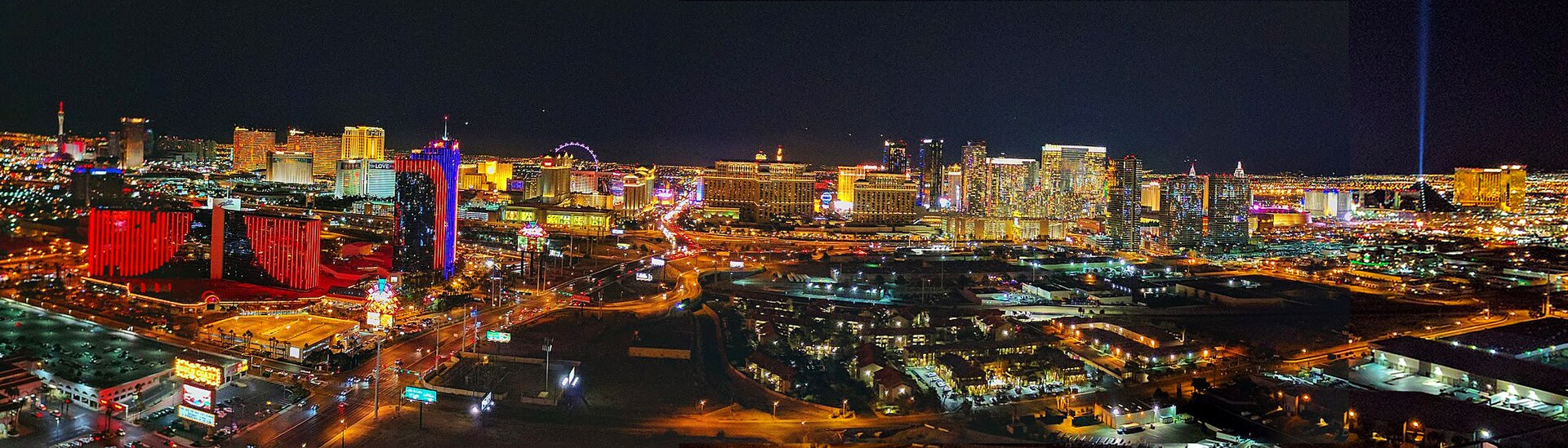
Las Vegas
Overview
Las Vegas is a city of about two and a half million people in the Mojave Desert, of which visitors see roughly four miles. The Strip, Las Vegas Boulevard South, is not actually in the city of Las Vegas but in the unincorporated communities of Paradise and Winchester, which is a piece of trivia with real consequences for how the place is governed and taxed.
The other thing worth knowing before arriving: the desert around it is the reason many people now come. Red Rock Canyon, Valley of Fire, the Hoover Dam and the Grand Canyon are all within reach, and they are the part of a Las Vegas trip most visitors remember.
Why Visit
As a spectacle it has no equivalent: a concentration of enormous themed resorts, residency shows, Cirque du Soleil productions and restaurants from well-known chefs, all within walking distance of each other.
And it is an unusually convenient base for the Southwest. Few cities put you within a couple of hours of a national conservation area, a reservoir, a slot-canyon state park and, at a stretch, one of the world's great canyons.
Best Things to Do
- Walk the Strip after dark, once, end to end or in sections. The scale reads differently on foot, and the free spectacles (the Bellagio fountains, the Mirage's volcano-style shows where operating, the casino interiors themselves) cost nothing.
- Fremont Street and downtown. The original Las Vegas: older casinos, the Fremont Street Experience canopy, and the Neon Museum's boneyard of salvaged signs, which is the best museum in the city.
- A show. Cirque du Soleil productions, headline residencies and long-running magic and comedy acts run nightly. Prices vary enormously by seat and date.
- Red Rock Canyon. A National Conservation Area twenty minutes west, with a scenic drive and hiking trails among sandstone escarpments. Timed entry reservations apply in the busy season. Check before setting off.
- Valley of Fire State Park. An hour northeast: red Aztec sandstone, petroglyphs and slot formations, and far quieter than the better-known parks.
- Hoover Dam and Lake Mead. Forty minutes southeast, with the bypass bridge walkway giving the classic view of the dam.
- Eat seriously. The restaurant scene is one of the densest in the country, and the buffet is no longer the main story.
Map
Map data © OpenStreetMap contributors
Best Time to Visit
March to May and October to November are the comfortable months, with warm days and cool evenings, the right conditions for both the Strip and the desert parks.
June to September is extremely hot, routinely above 40°C, and outdoor sightseeing becomes an early-morning activity only. Hotel rates often fall in the worst of it. The brief monsoon period in late summer brings occasional flash flooding in the canyons.
December to February is mild by day and genuinely cold at night, with the lowest rates outside major events; the desert parks are pleasant and empty.
Rates here are driven by the convention calendar and major events more than by season: the same room can double in price for a large trade show, so check what is on for your dates.
Where to Stay
The centre of the Strip, around the Bellagio, Caesars Palace and Cosmopolitan, minimises walking between the main attractions and is the most expensive.
The north Strip and the south Strip are cheaper, with longer walks or a monorail ride between them: distances are much greater than they appear, because the resorts are enormous.
Downtown / Fremont Street is significantly cheaper, more compact and has the older character; it is a fifteen-minute drive from the Strip.
Off-Strip resorts nearby offer better value and usually free parking, at the cost of needing transport.
Nearly every resort charges a mandatory nightly resort fee that is not included in the advertised room rate, and many now charge for parking. Compare the total, not the headline.
Neighborhoods
The Strip: the resort corridor, divided informally into north, centre and south.
Downtown and Fremont East: the original casino district, plus a bar and music scene east of it.
The Arts District (18b): galleries, breweries, vintage shops and murals, between downtown and the Strip.
Chinatown / Spring Mountain Road: the best everyday eating in the city.
Summerlin: a planned residential community on the western edge, next to Red Rock Canyon.
Henderson: a separate city to the southeast, quieter, with access toward Lake Mead.
Transportation & Airports
The Strip looks walkable and is not, in the way visitors expect: resorts are vast, the pavement routes wind through casinos and over pedestrian bridges, and a gap of a few hundred metres on a map can be a twenty-minute walk in heat.
The monorail runs along the east side of the Strip between several resorts. Buses run the length of the boulevard. Ride-hailing is widely used and is often faster than driving yourself because of resort parking layouts.
A hire car is worth it for the desert parks and the Grand Canyon and is otherwise a cost. Most resorts now charge for self-parking.
The airport is unusually close to the Strip, under fifteen minutes by road, which makes short trips practical.
Food
Las Vegas has become a serious restaurant city. Chefs with international reputations operate outposts in the resorts, and the competition means quality at the top is high.
The buffets remain, though fewer than before and more expensive; they are worth it as an occasion rather than as a cheap meal.
The better value is off the Strip. Chinatown on Spring Mountain Road is a long strip of Chinese, Korean, Japanese, Thai and Vietnamese restaurants used by residents, at a fraction of Strip prices. Downtown has an independent scene around the Arts District.
Practical notes: sales tax is added at the till, tipping is expected throughout (including for drinks served on the casino floor, which are complimentary while you are playing but not free of a tip) and an automatic service charge appears on many larger bills.
Day Trips
Red Rock Canyon National Conservation Area: twenty minutes west; a thirteen-mile scenic loop and trails of every length. Timed entry reservations apply during the peak months.
Valley of Fire State Park: an hour northeast; Nevada's oldest state park, with red rock formations and ancient petroglyphs.
Hoover Dam and Lake Mead: forty minutes southeast, with dam tours and the Mike O'Callaghan–Pat Tillman Memorial Bridge walkway.
Grand Canyon West: around two and a half hours, on Hualapai tribal land, home of the Skywalk. The South Rim, the classic national park view, is four to five hours each way: an overnight rather than a day trip, whatever the coach tours suggest.
Death Valley National Park: about two hours west, and the hottest place on earth by recorded temperature; a winter and spring destination only.
Budget
Las Vegas can be one of the cheapest or most expensive US cities depending entirely on choices. Rooms are subsidised by the expectation that you will spend elsewhere, so the advertised rate is often low and the extras are not.
Budget explicitly for: the mandatory resort fee per night, parking, tips throughout, and the substantial gap between menu prices on and off the Strip.
Free or cheap: walking the Strip and its casino interiors, the Bellagio conservatory and fountains, the Fremont Street canopy show, hiking at Red Rock, and the off-Strip restaurants in Chinatown.
On gambling, the only sound budgeting advice is to decide the amount you are willing to lose before you start and treat it as the price of the entertainment. The house edge is built into every game.
Travel Tips
Check the resort fee and parking charges before booking. They can add a substantial amount per night and are not in the headline rate.
Check the convention calendar for your dates. A large trade show transforms both prices and queues.
Distances deceive. Allow far more time than the map suggests to move along the Strip, especially in summer heat.
Take the desert seriously. Carry more water than you think you need on any trail, start early, and never rely on phone signal in the canyons.
Drinking in public is legal on the Strip in plastic containers but not in glass, and not in the surrounding city; open containers in a vehicle are illegal everywhere.
The legal age is 21 for both gambling and alcohol, and identification is checked regardless of apparent age.
Other Cities in United States


Frequently Asked Questions
How many days do I need in Las Vegas
Two or three nights is enough for the Strip, a show and downtown. Add two more if you want Red Rock, Valley of Fire, Hoover Dam or an overnight to the Grand Canyon.
What is a resort fee
A mandatory nightly charge added by nearly every resort on top of the room rate, covering things like wifi and the fitness centre whether or not you use them. It is disclosed at booking but not in the headline price, so compare totals.
Can I visit the Grand Canyon in a day
Grand Canyon West, on Hualapai land, yes, around two and a half hours each way. The South Rim in the national park is four to five hours each way, which makes a day trip a very long day with little time at the rim. An overnight is much better.
Is it only about gambling
No. Shows, restaurants, pools, museums such as the Neon Museum, and the surrounding desert parks all work without setting foot at a table. Plenty of visitors never gamble.
When is it too hot
June through September regularly exceeds 40°C. The city functions indoors, but hiking and long outdoor walking are dawn-only activities in those months.
Plan your trip to Las Vegas
Free tools for flight times, time differences, budget, money and plugs.
- Flight Duration CalculatorWork out real flight time across time zones.
- Time Zone ConverterFind the time in another city instantly.
- Trip Budget CalculatorEstimate your total trip cost, item by item.
- Currency ConverterConvert prices between currencies at indicative rates.
- Travel Plug & Voltage CheckerCheck if you need a plug adapter or voltage converter.
- Jet Lag CalculatorEstimate how many days you need to beat jet lag.