
Overview
The Dead Sea lies in the Jordan Rift Valley, its surface more than 400 metres below sea level. The lowest exposed point on the earth's land surface. It is a terminal lake: the Jordan River flows in and nothing flows out, so evaporation has concentrated the water to several times the salinity of the ocean.
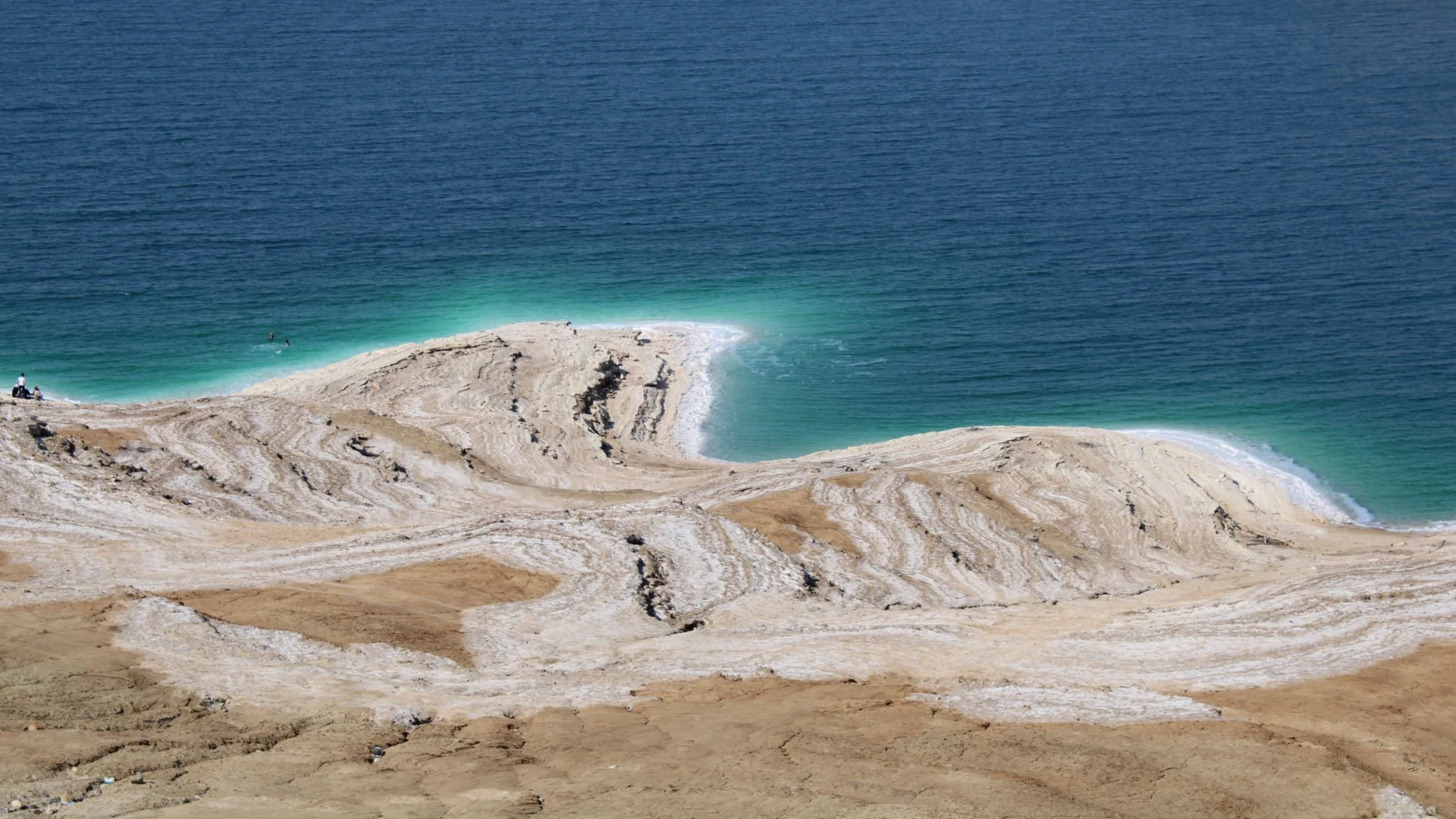
That density is why swimmers float without effort. It is also why nothing larger than microorganisms lives in it, and why the shoreline is crusted with salt formations. The lake has been shrinking for decades as water is diverted upstream, and the retreating shore has left sinkholes along parts of the western side.
The western shore is reached from Jerusalem, the eastern from Amman, and both have resort areas, public beaches and spa facilities.
Why Visit
Floating in the Dead Sea is genuinely unlike swimming anywhere else, and the setting (desert cliffs, hazy blue water, salt crystals along the shore) is spectacular in its own right.
The mineral mud and the mineral-rich water have been used for skin treatments since antiquity, and the low altitude means the sunlight arrives filtered through a thicker layer of atmosphere, which is why the area has a long history as a therapeutic destination.
It also sits between two major archaeological sites, Masada and Qumran, which makes a single day unusually full.
Top Experiences
- Float, briefly. Twenty minutes in the water is the usual recommendation. Lie back rather than swimming; the salt makes normal strokes uncomfortable.
- Mud. Black mineral mud is applied at most beaches and resorts, left to dry and rinsed off in the lake and then in fresh water.
- Masada. The clifftop fortress above the western shore, a UNESCO World Heritage site, reached by cable car or the Snake Path. Sunrise from the summit is the classic version.
- Qumran. The caves where the Dead Sea Scrolls were found in the 1940s, with a visitor centre explaining the site.
- Ein Gedi. A desert oasis nature reserve with spring-fed waterfalls, ibex and rock hyrax, and short walks in a canyon.
- The eastern shore. From the Jordanian side, the Dead Sea Panoramic Complex and the road down from the Jordan Valley highway give the widest views.
Map
Map data © OpenStreetMap contributors
Best Time to Visit
March to May and October to November are the most comfortable: warm water, strong sun and temperatures that allow walking at Masada and Ein Gedi.
June to September is extremely hot, regularly above 40°C, and outdoor sites are dangerous in the middle of the day. If visiting then, do Masada and Ein Gedi at dawn and use the water and shade afterwards.
December to February is mild and pleasant by day and cool at night; the water stays warm enough to enter year-round.
Where to Stay
On the Israeli side, Ein Bokek is the main resort strip, with hotels directly on maintained public beaches and free access to the water.
Ein Gedi has a kibbutz guesthouse and a field school, closer to the nature reserve and quieter.
On the Jordanian side, the resort cluster at Sweimeh holds most of the international hotels, with private beaches and spas.
Many visitors stay in Jerusalem or Amman instead and come for the day, which works but means the drive twice in one day.
Getting There
From Jerusalem, Ein Bokek is roughly two hours by road; Qumran and Ein Gedi are closer. Buses run to the main beaches and to Masada, and organised day tours combining Masada, Ein Gedi and the sea are common.
From Amman, the Jordanian resorts are around an hour by road down the Jordan Valley.
From Eilat or Tel Aviv, expect three hours or more. There is no rail access, so it is a road journey or a tour from any direction.
Getting Around
A car gives the most freedom: the sites are strung along a single road and parking is available at each.
Public buses on the Israeli side link Jerusalem and Beer Sheva with Ein Bokek, Ein Gedi and Masada, but services are infrequent and the last departures are early. Check times before relying on them.
On the Jordanian side there is very little public transport; taxis arranged through a hotel, or a hire car, are the practical options.
Top Attractions
Masada: the Herodian fortress on an isolated plateau, with the Roman siege ramp still visible below and a cable car from the eastern side.
Ein Gedi Nature Reserve: freshwater canyons and waterfalls in the desert, with marked walks of an hour upwards.
Qumran National Park: the settlement and caves associated with the Dead Sea Scrolls.
Ein Bokek beaches: the maintained, free public beaches with showers and shade on the Israeli side.
Mount Nebo and Bethany Beyond the Jordan: on the Jordanian side, the traditional site of Moses' view of the promised land and the baptism site, both within reach of the eastern shore.
Food & Culture
Food in the resort areas is mostly hotel buffets and a small number of restaurants; this is not a region to come to for eating, and there are few independent options once you leave the hotels.
Bring water. The combination of heat, low humidity and salt dehydrates faster than most visitors expect, and there are long stretches of road with nothing on them.
The area is culturally quiet: a place of spas, archaeology and desert rather than towns. The nearest real cities are Jerusalem, Amman and Beer Sheva.
Budget
Beach access at the main Israeli public beaches, including Ein Bokek, is free and facilities are provided. Hotel and spa stays, by contrast, are expensive on both sides of the lake.
The main costs are accommodation, national park entries and transport, since the distances make a car or an organised tour close to necessary. Eating is limited and priced accordingly, so bringing water and food for a day trip saves both money and time.
Entry, Tickets & Permits
No permit is required to visit the shore. National park sites (Masada, Ein Gedi, Qumran on the Israeli side) charge admission, and a combined national parks pass can be worthwhile if you visit several.
Crossing between Israel, the West Bank and Jordan involves land border formalities that change; check current entry requirements, opening hours and any visa arrangements with official sources well before travelling.
Check your government's current travel advice for the region before booking, as conditions and access change.
Important Notes
Do not put your head under. The water causes severe pain in the eyes and is dangerous if swallowed. If it gets in your eyes, rinse with fresh water immediately and do not rub.
Do not shave beforehand. Any cut, graze or recent shaving will sting sharply.
Limit time in the water. Around twenty minutes is the standard advice; the mineral concentration is hard on skin beyond that.
Wear water shoes. Salt crystals on the lake bed are sharp.
Sinkholes are a real hazard along parts of the retreating western shore. Use marked, supervised beaches only, and observe closure signs.
Heat is dangerous in summer. Above 40°C is common; carry far more water than usual and avoid midday exertion.
Itinerary Suggestions
One long day from Jerusalem: leave before dawn for Masada, take the cable car up for sunrise, descend by mid-morning, walk at Ein Gedi, then float and use the mud at Ein Bokek in the afternoon.
Two days: stay overnight at Ein Bokek or Ein Gedi. Masada and Qumran on day one, Ein Gedi and a slow afternoon at the water on day two.
From Amman: a half day at the Sweimeh resorts combines easily with Mount Nebo, Madaba and the baptism site on the way back.
Frequently Asked Questions
Can everyone float in the Dead Sea
Yes. The salinity makes the water dense enough that a body floats without effort. Lie back rather than trying to swim normally.
How long should I stay in the water
About twenty minutes is the usual advice. Longer is uncomfortable and hard on the skin.
Is the Dead Sea really shrinking
Yes. Water diversion upstream has caused the level to drop over decades, and the retreating shoreline has produced sinkholes in places, which is why only supervised beaches should be used.
Can I visit Masada and the Dead Sea in one day
Yes, and it is the standard day trip from Jerusalem. Start before dawn for Masada to avoid the heat.
Plan your trip to The Dead Sea
Free tools for flight times, time differences, budget, money and plugs.
- Flight Duration CalculatorWork out real flight time across time zones.
- Time Zone ConverterFind the time in another city instantly.
- Trip Budget CalculatorEstimate your total trip cost, item by item.
- Currency ConverterConvert prices between currencies at indicative rates.
- Travel Plug & Voltage CheckerCheck if you need a plug adapter or voltage converter.
- Jet Lag CalculatorEstimate how many days you need to beat jet lag.

