
Casablanca
Overview
Casablanca sits on Morocco's Atlantic coast and is the country's business centre, its main port and its largest city by a wide margin. It is not an imperial city and has no great medieval medina; what it has instead is the twentieth century.
Under the French protectorate the city was laid out with wide boulevards and built in a distinctive style (Mauresque, blending art deco with Moroccan ornament) which survives in the centre around Boulevard Mohammed V and Place Mohammed V.
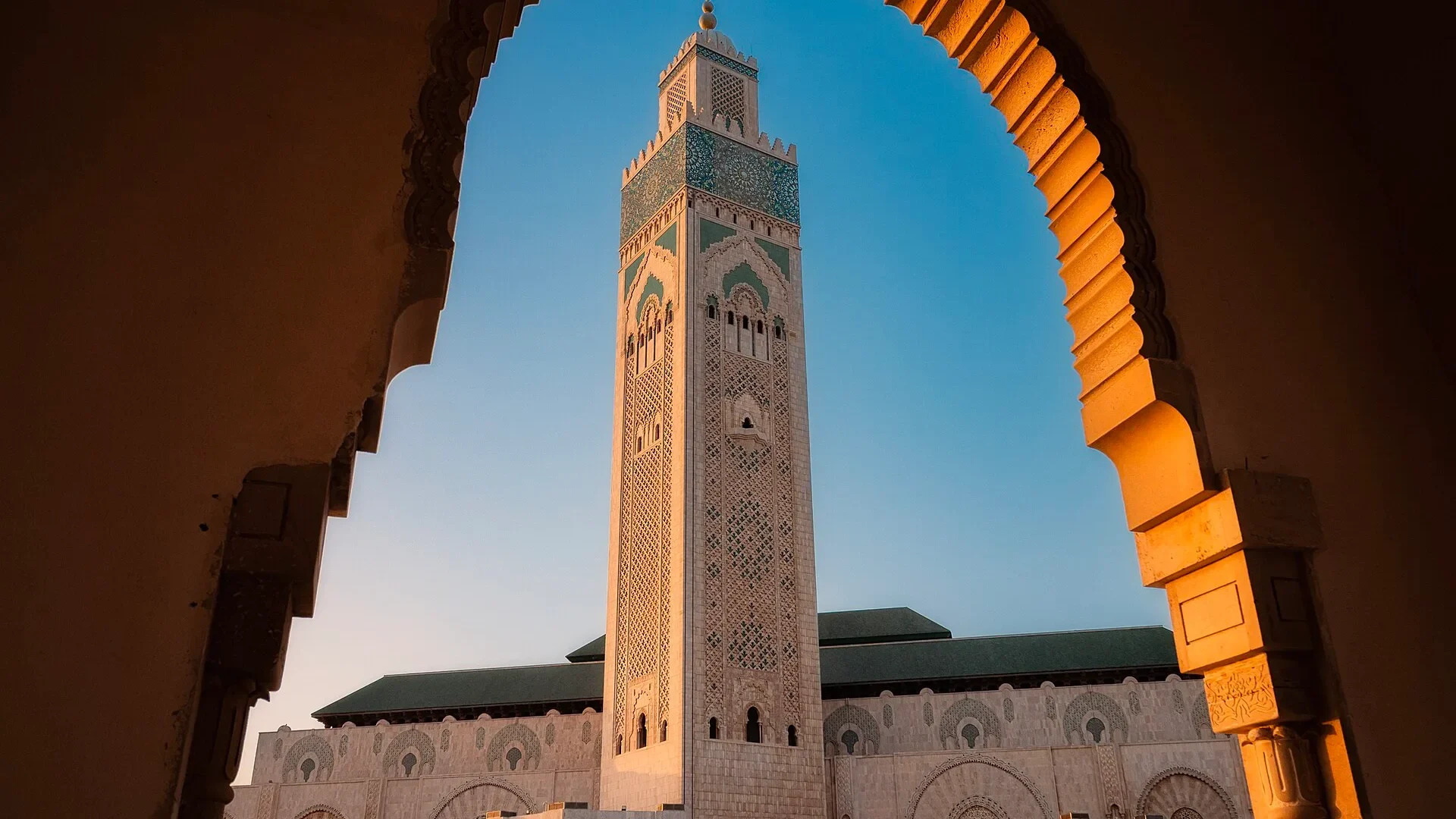
On the seafront stands the Hassan II Mosque, completed in 1993, with a minaret of 210 metres and part of the prayer hall built out over the Atlantic.
Why Visit
The Hassan II Mosque is one of the very few mosques in Morocco that non-Muslims may enter, on guided tours, and it is on a scale that makes the trip worthwhile in itself.
Casablanca is also the best place in the country to see early twentieth-century architecture, and it shows contemporary Morocco (its business, its restaurants, its coastline) more honestly than the tourist cities do.
Best Things to Do
- Hassan II Mosque. Guided tours admit non-Muslims at set times. The scale, the cedar ceiling that opens, and the glass floor over the sea are the reasons to go.
- The art deco centre. Boulevard Mohammed V, Place Mohammed V and the surrounding streets, with the former courthouse, the post office and the Rialto cinema.
- The Old Medina. Small and modest by Moroccan standards, north of the centre near the port, and worth an hour rather than a day.
- Habous (New Medina). Built in the 1920s in a traditional style, with olive and book sellers and better-organised souks than the old medina.
- La Corniche and Ain Diab. The seafront strip west of the mosque, with cafés, beach clubs and the Atlantic surf.
- Villa des Arts. A restored art deco villa housing contemporary Moroccan art.
- Mahkama du Pacha. A 1950s courthouse and administrative building in Habous, richly decorated with zellij and carved cedar; opening varies.
Map
Map data © OpenStreetMap contributors
Best Time to Visit
April to June and September to November are the best: warm but moderated by the Atlantic, with clear light.
July and August are hot but far less extreme than inland Morocco, and the beaches and Corniche are at their busiest.
December to March is mild and the wettest period, with grey days and Atlantic wind.
Coastal fog and haze are common in the mornings for much of the year and usually clear by midday.
Where to Stay
The city centre, around Boulevard Mohammed V and the art deco quarter, is the most practical: walkable, near the tram and the main train station.
Gauthier and Racine are the pleasant central residential districts, with the best restaurants and cafés.
Ain Diab and the Corniche put you on the sea near the mosque, with resort-style hotels and a longer ride into town.
Near Casa-Voyageurs station suits a short stopover, since it is the terminus for the high-speed line to Tangier and trains to Marrakech.
Neighborhoods
Centre Ville: the art deco core, with the main boulevards, the Marché Central and the administrative square.
Old Medina: the small walled quarter near the port.
Habous: the 1920s new medina, with orderly souks and the Mahkama.
Gauthier and Racine: central, residential, with restaurants, galleries and cafés.
Ain Diab and La Corniche: the beachfront strip west of the Hassan II Mosque.
Anfa: the affluent hillside district above the coast.
Transportation & Airports
A modern tram network crosses the city and is the easiest public option; tickets are cheap and lines connect the centre, the stations and the university districts.
Petit taxis (red) are metered by law; ask for the meter. Ride-hailing apps also operate.
Casa-Voyageurs is the main railway station, with the Al Boraq high-speed service to Rabat and Tangier and ordinary trains to Marrakech and Fes. Mohammed V Airport is around thirty kilometres south and connected to both main stations by a direct train.
Food
Casablanca is the best city in Morocco for seafood, being a working Atlantic port. Grilled sardines, sole, and the fish stalls at the Marché Central are the simplest way in.
Moroccan standards are all here (tagine, couscous on Fridays, harira, pastilla) alongside a strong French-influenced café and bakery culture inherited from the protectorate.
Street food in the old medina and Habous includes msemen, harcha and sfenj. The city also has the country's most developed contemporary restaurant scene, concentrated in Gauthier and along the Corniche.
Day Trips
Rabat, the national capital, is under an hour by high-speed train, with the Kasbah of the Udayas, the Hassan Tower and the Chellah necropolis. Its historic centre is a UNESCO World Heritage site and it makes an easy and rewarding day.
El Jadida, about ninety minutes south along the coast, has a Portuguese fortified town, also UNESCO-listed, with a remarkable vaulted cistern.
Azemmour, nearby, is a small walled town on the river with murals and a quiet medina.
Marrakech is around three hours by train and better as an overnight than a day trip.
Budget
Casablanca is more expensive than the rest of Morocco for accommodation and restaurants, being a business city, but still moderate by European standards.
Street food, market fish and the set menus at central cafés keep eating cheap. Trams and trains are inexpensive, including the airport service. The mosque tour is the main fixed cost, and the art deco walking routes, the Corniche and the medinas are free.
Travel Tips
Check the mosque tour times before going. Visits for non-Muslims run at set hours and do not take place during Friday prayers.
Dress modestly for the mosque. Shoulders and knees covered; shoes are removed and carried.
Insist on the taxi meter in petit taxis, or use an app.
Take the train from the airport. It runs to both main stations and avoids negotiating a taxi fare on arrival.
Do not expect a tourist medina. Casablanca is a working city; its interest is architectural and contemporary rather than medieval.
Other Cities in Morocco


Frequently Asked Questions
How many days do I need in Casablanca
One full day covers the mosque, the art deco centre and Habous. A second allows the Corniche and a slower look at the architecture.
Can non-Muslims enter the Hassan II Mosque
Yes, on guided tours at set times. It is one of the very few mosques in Morocco open to non-Muslims.
Is Casablanca worth visiting
For the mosque, the twentieth-century architecture and the seafood, yes. If you are looking for medieval medinas, Fes and Marrakech are the cities for that.
Is Rabat a day trip
Yes. The high-speed train takes under an hour each way, which makes a comfortable day.
Plan your trip to Casablanca
Free tools for flight times, time differences, budget, money and plugs.
- Flight Duration CalculatorWork out real flight time across time zones.
- Time Zone ConverterFind the time in another city instantly.
- Trip Budget CalculatorEstimate your total trip cost, item by item.
- Currency ConverterConvert prices between currencies at indicative rates.
- Travel Plug & Voltage CheckerCheck if you need a plug adapter or voltage converter.
- Jet Lag CalculatorEstimate how many days you need to beat jet lag.