
Chefchaouen
Overview
Chefchaouen sits at around 600 metres in the Rif mountains of northern Morocco, below the twin peaks that give it its name. Founded in the fifteenth century, it took in Muslims and Jews expelled from Spain, which shaped its architecture: whitewashed, red-tiled, Andalusian in plan.
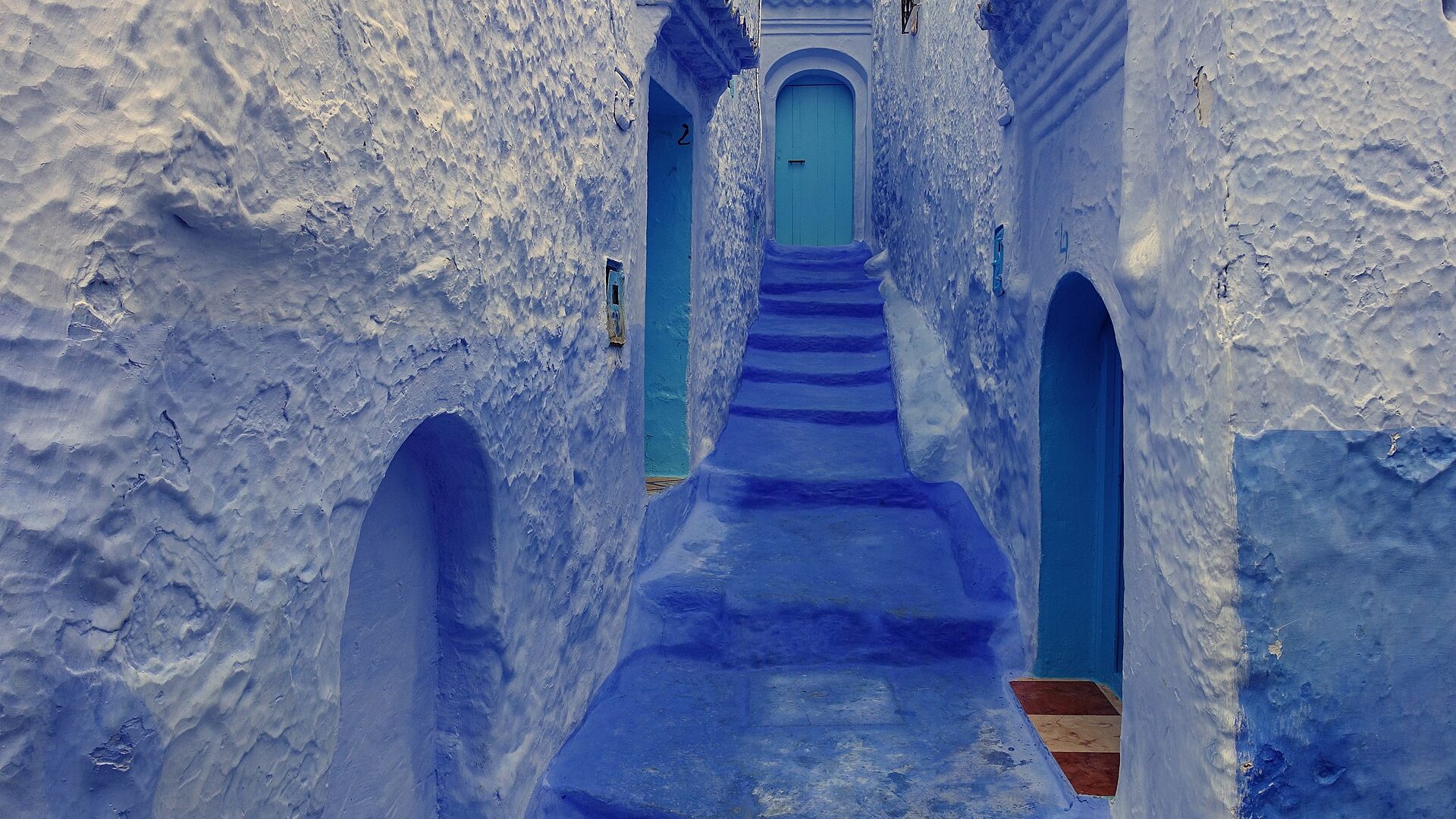
The blue that now covers the medina is a more recent tradition, applied and reapplied by residents, and it is the reason most visitors come. The town is small enough to walk end to end in half an hour, and the mountains begin where the streets stop.
Why Visit
Chefchaouen is the most photogenic town in Morocco and one of the most relaxed: the medina is compact, largely free of hassle by Moroccan standards, and the pace is set by the mountains rather than by commerce.
It also works as a walking base. The Rif hills and the Talassemtane National Park start at the edge of town, with the Akchour waterfalls and God's Bridge within a short drive.
Best Things to Do
- Walk the blue medina, early. Before about nine in the morning the lanes are empty and the light is best; by midday the narrow staircases fill.
- Plaza Uta el-Hammam. The main square, shaded by trees, with cafés and the mosque's octagonal minaret.
- The Kasbah. A fifteenth-century fortress on the square, with gardens, a small museum and a tower to climb.
- The Spanish Mosque. A ruined 1920s mosque on the hill east of town, a twenty-minute walk up, and the classic sunset viewpoint over the medina.
- Ras el-Maa. The spring at the top of the medina where water comes out of the mountain and residents still wash clothes.
- The weaving workshops. Chefchaouen is known for wool blankets and djellabas, still woven on wooden looms in the medina.
- Akchour. Waterfalls and a natural rock arch about forty minutes away, with walks of a few hours in either direction.
Map
Map data © OpenStreetMap contributors
Best Time to Visit
April to June and September to October are the best: warm days, cool mountain nights and clear light on the blue.
July and August are hot and busy, with Moroccan domestic tourism at its peak and the medina crowded through the day.
November to March is cool to cold, with rain and occasional snow on the peaks. The town is at its quietest and the blue is at its most saturated under grey skies, though many guesthouses are poorly heated.
Where to Stay
Inside the medina is the obvious choice: small riads and guesthouses with terraces, most within a few minutes of the main square. Expect stairs and a short walk from wherever a taxi can stop.
Near Bab el-Ain, the main medina gate, keeps that walk shortest.
The Ville Nouvelle, below the medina, has larger and cheaper hotels with parking, at the cost of atmosphere.
Above the medina, a few places sit on the slope with views across the rooftops, but involve a steep climb each time.
Neighborhoods
The medina: the blue old town, entirely pedestrian, centred on Plaza Uta el-Hammam and the kasbah.
Bab el-Ain: the main western gate and the busiest entrance.
Ras el-Maa: the upper eastern edge, where the spring emerges and the path to the Spanish Mosque begins.
Ville Nouvelle: the modern town below, with the bus station, banks and larger hotels.
Transportation & Airports
Chefchaouen has no airport and no railway. Access is by road: CTM and other coaches run from Tangier, Fes, Casablanca and Rabat, and grands taxis connect from Tetouan and Tangier.
From Tangier the journey is around two to three hours; from Fes, roughly four.
The medina is entirely pedestrian and steep in places. Everything within town is walkable; taxis handle the trip to Akchour and the national park trailheads, usually on an agreed return fare.
Food
Rif cooking is simpler than the imperial cities'. Tagines with local vegetables, bissara (a thick fava bean soup eaten for breakfast with olive oil and cumin) and grilled meats are the staples.
The area produces goat's cheese, unusual in Morocco, and it appears on menus around the square.
Mint tea and fresh orange juice are everywhere. Alcohol is largely unavailable in the medina, which is typical of small Moroccan towns.
Day Trips
Akchour is the main excursion: waterfalls and the natural arch known as God's Bridge, reached in about forty minutes by taxi, with walks of two to five hours once there.
Talassemtane National Park surrounds the town, with fir forest and marked trails; a local guide is advisable for longer routes.
Tetouan, around an hour north, has a UNESCO-listed medina with strong Andalusian character and far fewer visitors.
Tangier is two to three hours away and is usually the next stop rather than a day trip.
Budget
Chefchaouen is one of the cheapest places to stay in Morocco. Guesthouses in the medina are inexpensive, meals around the square cost little, and there are almost no entry fees. The kasbah is the main one.
The costs are transport in and out, and taxis to Akchour, which are usually agreed as a round trip with waiting time. Shopping for blankets and woven goods is the other place a budget goes.
Travel Tips
Photograph early. The medina is quiet before nine and increasingly crowded after eleven.
Ask before photographing people or doorways, and expect that some residents will ask for payment. A number of the most photogenic corners are private thresholds.
Wear shoes with grip. The lanes are stepped, uneven and slippery when wet.
Cannabis is grown in the surrounding Rif and is offered to visitors. It is illegal in Morocco and buying it carries real risk.
Book the return coach when you arrive. Services from Chefchaouen are limited and fill in high season.
Other Cities in Morocco


Frequently Asked Questions
How many days do I need in Chefchaouen
One full day covers the medina and the Spanish Mosque. Two allow Akchour or a walk in the national park, which most visitors are glad they made room for.
Why is the town blue
Several explanations are given locally, including Jewish tradition, keeping mosquitoes away and simply keeping the walls cool. The practice as it is seen today is relatively recent and is maintained by residents.
How do I get there
By road only: coach or grand taxi from Tangier, Tetouan or Fes. There is no airport or railway station.
Is Chefchaouen touristy
The medina is busy with day visitors in the middle of the day, particularly in summer. Early mornings, evenings and the surrounding hills are quiet.
Plan your trip to Chefchaouen
Free tools for flight times, time differences, budget, money and plugs.
- Flight Duration CalculatorWork out real flight time across time zones.
- Time Zone ConverterFind the time in another city instantly.
- Trip Budget CalculatorEstimate your total trip cost, item by item.
- Currency ConverterConvert prices between currencies at indicative rates.
- Travel Plug & Voltage CheckerCheck if you need a plug adapter or voltage converter.
- Jet Lag CalculatorEstimate how many days you need to beat jet lag.