
Fes
Overview
Fes was founded in the late eighth century and was Morocco's capital for long stretches of its history. Fes el-Bali, the old medina, is a UNESCO World Heritage site and one of the best-preserved medieval cities in the Arab world: a dense maze of covered lanes, fondouks, mosques and workshops with no vehicle access, where goods still move by handcart and mule.
Beside it lies Fes el-Jdid, the fourteenth-century extension with the royal palace and the mellah, and west of both is the Ville Nouvelle, built under the French protectorate, with wide boulevards and the modern city's offices and cafés.
Why Visit
Fes is the least compromised of Morocco's imperial cities. Trades are still practised where they always were (tanning, brass, weaving, ceramics) and the medina functions as a living city rather than a preserved one.
It is also the home of al-Qarawiyyin, founded in 859, whose mosque and associated madrasa and library form one of the oldest continuously operating centres of learning anywhere.
Best Things to Do
- Get lost in Fes el-Bali, on purpose. The medina cannot be navigated by map. Follow the main downhill arteries, Talaa Kebira and Talaa Seghira, and accept that you will need to ask the way.
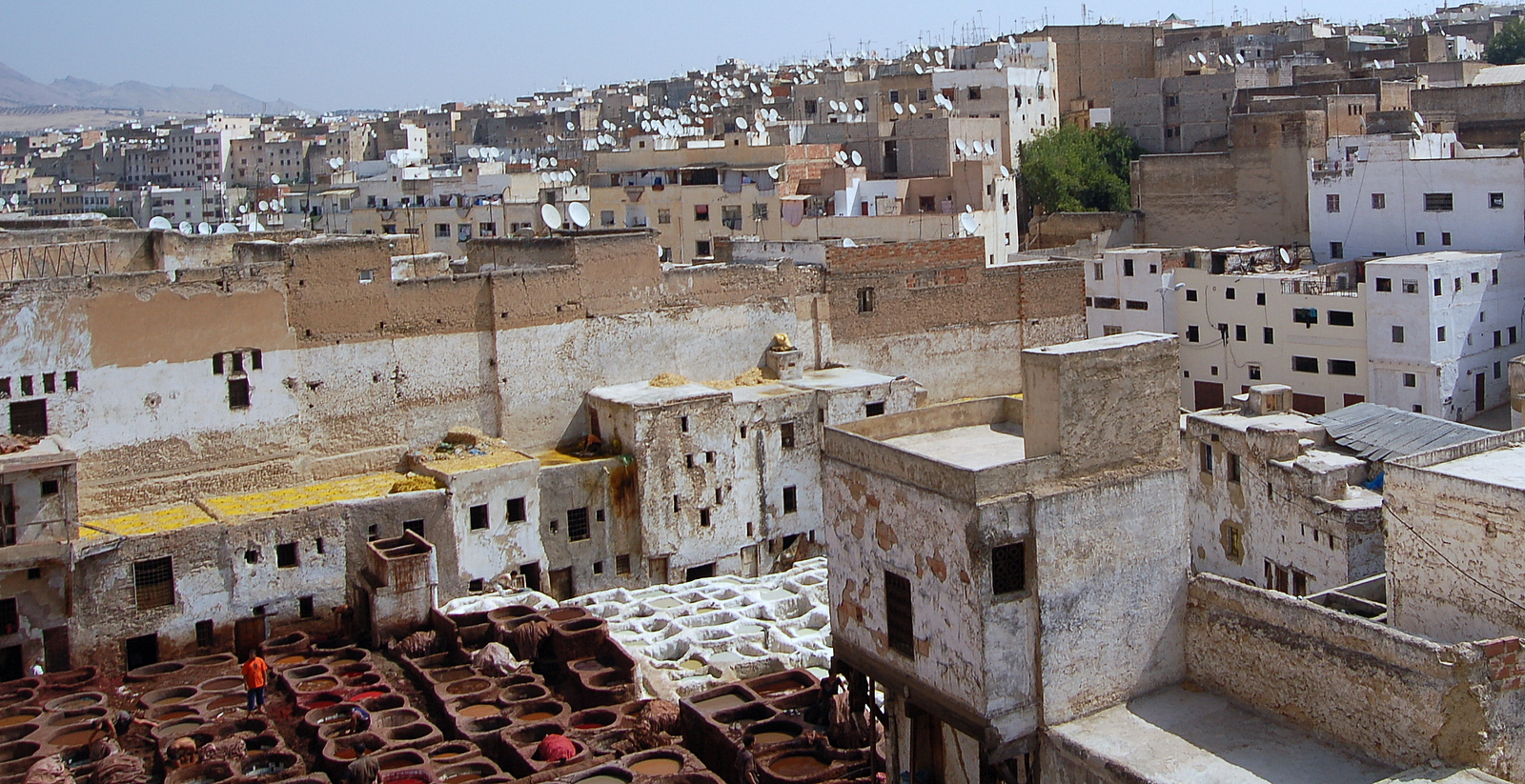
- Chouara tannery. The stone vats of dye and lime, seen from the terraces of surrounding leather shops. You will be handed mint for the smell and expected to browse.
- Bou Inania Madrasa. A fourteenth-century Marinid religious school with carved cedar, stucco and zellij tilework, and one of the few religious buildings open to non-Muslims.
- Al-Attarine Madrasa. Smaller, and at least as fine, near the Qarawiyyin.
- Bab Bou Jeloud. The blue gate, the main western entrance to the medina and the usual starting point.
- Dar Batha. A former palace, now a museum of Moroccan arts and crafts, with an Andalusian garden.
- The Merinid Tombs. Ruins on the hillside north of the medina, best at sunset for the view over the whole city.
Map
Map data © OpenStreetMap contributors
Best Time to Visit
March to May and September to November are the best: warm days, cool evenings, and the medina bearable to walk for hours.
June to August is very hot inland, Fes has no coastal moderation, and walking the medina in the afternoon is hard work.
December to February is cool and can be genuinely cold and wet at night; riads are often under-heated.
During Ramadan, daytime rhythms change: many restaurants close during daylight and the medina comes alive after sunset.
Where to Stay
A riad inside the medina is the experience worth having: a courtyard house behind a plain door, often centuries old. Expect to walk the last stretch, and arrange for someone to meet you, because taxis cannot reach most addresses.
Near Bab Bou Jeloud keeps the walk from a taxi short.
Ville Nouvelle has conventional hotels, car access and restaurants, at the cost of atmosphere; it is a taxi ride from the medina gates.
Fes el-Jdid is quieter and between the two.
Neighborhoods
Fes el-Bali: the main medina, with the Qarawiyyin, the souks, the tanneries and the madrasas.
Andalusian quarter: the eastern half of the old medina across the river, quieter and less visited.
Fes el-Jdid: the Marinid extension, with the royal palace gates, the mellah and the Jewish cemetery.
Ville Nouvelle: the twentieth-century city, with the train station, cafés and modern hotels.
The hillsides: the Merinid tombs to the north and the Borj Sud fort to the south, both viewpoints over the medina.
Transportation & Airports
The medina is entirely pedestrian. Nothing motorised gets in, and mules and handcarts still carry goods; step aside when you hear balak.
Petit taxis (red) work within the city and should use the meter; agree before setting off if they will not. Grands taxis (larger, shared) handle intercity routes.
Trains connect Fes to Casablanca, Rabat, Marrakech and Tangier from the station in the Ville Nouvelle, and are comfortable and good value. Fes–Saïs Airport is a short drive south.
Food
Fassi cooking is the most refined in Morocco. Pastilla (a layered pie of pigeon or chicken with almonds, cinnamon and sugar) is the city's signature dish.
Tagines here lean towards sweet and savoury combinations with prunes and apricots. Harira, the tomato and lentil soup, is the standard opener, especially during Ramadan.
Street food in the medina includes maakouda potato cakes, sfenj doughnuts and fresh msemen. Mint tea is poured from a height at every opportunity, and refusing it is harder than accepting.
Day Trips
Meknes, about an hour by train, is the quietest of the imperial cities, with the monumental Bab Mansour and a relaxed medina.
Volubilis, near Meknes, is the best-preserved Roman site in Morocco and a UNESCO World Heritage site, with mosaics still in place.
Moulay Idriss Zerhoun, on a hillside beside Volubilis, is one of the country's holiest towns and combines naturally with it.
Ifrane and the Middle Atlas, south, bring cedar forest, Barbary macaques and a change of climate; Chefchaouen is around four hours north-west and better as an overnight.
Budget
Fes is inexpensive. Riads span budget to luxury and are good value compared with European cities; street food and medina restaurants cost very little.
Madrasa and museum entries are modest. The costs to watch are guides (an official guide for a first half day in the medina is genuinely useful) and shopping, where bargaining is expected and the first price is rarely the real one.
Travel Tips
Hire an official guide for your first morning. It converts the medina from bewildering to legible, and reduces the number of unsolicited offers of help.
Unofficial guides approach constantly. A firm, friendly no works; following someone who offers to show you a shortcut usually ends at a shop.
Dress modestly. Shoulders and knees covered is respectful and reduces attention, particularly for women.
Non-Muslims cannot enter working mosques in Morocco, including the Qarawiyyin prayer hall; the madrasas and the courtyards are open.
Carry cash. Most medina shops and all street stalls are cash only.
Other Cities in Morocco

Frequently Asked Questions
How many days do I need in Fes
Two full days cover the medina properly, with a third for Meknes and Volubilis.
Do I need a guide
Not strictly, but one official guide for a first half day makes the medina far easier to understand and navigate afterwards.
Fes or Marrakech
Fes is older, denser and less touched by tourism; Marrakech is more polished and easier. Travellers interested in craft, history and atmosphere usually prefer Fes.
Can I visit the tanneries
Yes, from the terraces of leather shops around them. There is no entry fee but you will be shown the shop, and a small tip is customary.
Plan your trip to Fes
Free tools for flight times, time differences, budget, money and plugs.
- Flight Duration CalculatorWork out real flight time across time zones.
- Time Zone ConverterFind the time in another city instantly.
- Trip Budget CalculatorEstimate your total trip cost, item by item.
- Currency ConverterConvert prices between currencies at indicative rates.
- Travel Plug & Voltage CheckerCheck if you need a plug adapter or voltage converter.
- Jet Lag CalculatorEstimate how many days you need to beat jet lag.