Petra
Overview
Petra was the capital of the Nabataeans, an Arab people who grew rich controlling the incense and spice routes between southern Arabia and the Mediterranean, and who carved their city’s monumental facades directly into rose and ochre sandstone from roughly the 4th century BCE. Rome annexed it in 106 CE; earthquakes and shifting trade routes did the rest, and by the medieval period it was known mainly to the Bedouin who lived among the tombs.
UNESCO inscribed Petra in 1985. What the listing makes clear, and what most photographs do not, is the scale: this is not a monument but a city spread over a mountainous landscape, with a processional way, a colonnaded street, temples, a theatre cut from rock, and hundreds of tombs across several valleys.
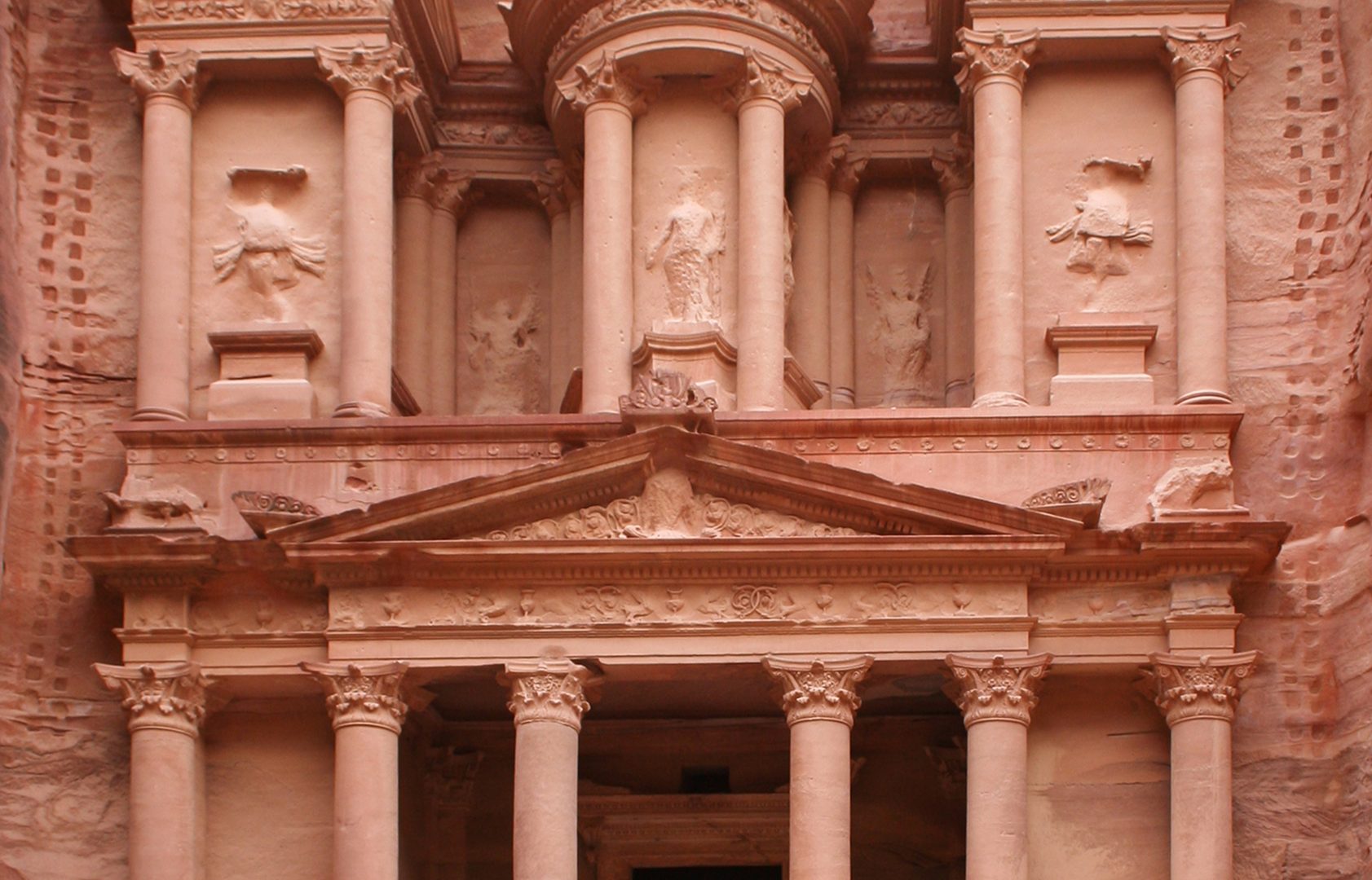
The Treasury — Al-Khazneh — that everyone comes for is about two kilometres from the gate, at the end of the Siq. It is the beginning of Petra, not the end of it.
Why Visit
Because of the approach. The Siq is a natural fissure over a kilometre long, in places barely three metres wide, with walls rising 80 metres or more. You walk it in shade and silence, past the channels the Nabataeans cut to bring water into the city, and the Treasury appears through a gap at the end. It is one of the great arrivals in travel and it cannot be photographed.
Because of the water engineering, which is the real Nabataean achievement. They built a city for tens of thousands of people in a desert receiving almost no rain, using dams, cisterns and ceramic pipes to capture flash floods and store them. The channels are still visible along the Siq walls.
And because of the climb to the Monastery — Ad-Deir — up around 800 rock-cut steps to a facade larger than the Treasury, with almost none of the crowds and a view over the Wadi Araba to the mountains of Israel.
Top Experiences
- Walking the Siq at opening time, before the horse carriages and the tour groups. The site opens at 06:00 in summer and 06:30 in winter; the first hour is the quietest of the day.
- The climb to the Monastery (Ad-Deir): around 800 steps, roughly 45 to 60 minutes up. The single best thing at Petra and the most consistently skipped.
- The High Place of Sacrifice: a shorter, steeper climb to a Nabataean altar with the whole basin laid out below. Descend the back route past the Garden Tomb rather than returning the way you came.
- The Royal Tombs in late afternoon, when the low sun brings out the banded colour in the sandstone that midday light flattens completely.
- Little Petra (Siq al-Barid): a satellite site 10 km north, free-standing, far quieter, with surviving painted ceiling frescoes.
- Petra by Night: the Siq lit by candle to the Treasury. Note that it is not included in the Jordan Pass and requires a separate ticket.
Map
Map data © OpenStreetMap contributors
Best Time to Visit
March to May and September to November are the right months: warm enough for early starts, cool enough to climb.
Summer is genuinely hard. The Siq is shaded but the basin beyond it is not, and the Monastery steps face the sun. If you visit between June and August, be at the gate when it opens and be off the climbs by mid-morning.
Winter brings cold, short days and occasional rain, and flash flood risk in the Siq, which is why the authority closes it when conditions warrant. It is also the emptiest and, in clear weather, the most atmospheric.
Within the day, the light matters as much as the season. The Treasury faces east and is lit in the morning; the Royal Tombs and the Monastery are best in the afternoon. Planning around that is the difference between good photographs and flat ones.
Where to Stay
Wadi Musa: the town above the site, with everything from hostels to five-star hotels. The relevant variable is how far uphill you are: the walk back from the gate at the end of a 15 km day is steep, and a hotel within a few hundred metres of the visitor centre is worth paying for.
Little Petra / Beidha: a handful of smaller places and Bedouin-run camps north of town, quieter and better for stars, but you will need a car.
Wadi Rum: not a Petra base, but the natural next stop. Camps range from basic Bedouin tents to the bubble domes that appear on social media.
Book the overnight stay before you buy the ticket: the entry price depends on it.
Getting There
Petra sits at Wadi Musa, a town built up the hillside above the visitor centre.
From Amman: roughly three hours by the Desert Highway, or a full and far better day by the King’s Highway through Madaba, Kerak and Dana. JETT runs a scheduled coach; hire cars are straightforward.
From Aqaba: about two hours, which makes Petra reachable from the Red Sea coast and from King Hussein International (AQJ).
From Wadi Rum: under two hours, and the standard pairing. Most itineraries run Amman → Petra → Wadi Rum → Aqaba or the reverse.
From Israel: via the Wadi Araba crossing near Eilat. Feasible in a day, but see the entry fees above before deciding.
Getting Around
Petra is walked, and the distances are larger than people expect. Visitor centre to the Treasury is about 2 km through the Siq, mostly gentle downhill. Treasury to the far end of the colonnaded street is another 2 km. The Monastery adds around 800 steps on top of that.
A full day covering the main trail and one climb is comfortably 15 km on uneven ground, and the return leg is uphill, in the afternoon, when you are tired.
Horses, carriages, donkeys and camels are offered constantly. The horse ride from the gate to the Siq entrance is nominally included in the ticket but a tip is expected. Animal welfare at the site has drawn criticism; walking is the straightforward answer, and the Monastery steps in particular are far better on foot.
Alternative trails: the Al-Khubtha trail to the viewpoint above the Treasury, and the back route into Petra from Little Petra, are both signposted and both dramatically quieter than the main path.
Top Attractions
- Al-Khazneh (the Treasury): the facade at the end of the Siq, a Nabataean royal tomb rather than a treasury.
- Ad-Deir (the Monastery): larger than the Treasury, reached by around 800 rock-cut steps.
- The Siq: the 1.2 km fissure that forms the entrance, with the Nabataean water channels still cut into its walls.
- The Royal Tombs: the Urn, Silk, Corinthian and Palace tombs, cut into the eastern cliff face.
- The Theatre: carved directly out of the rock, seating several thousand, later enlarged by the Romans.
- The High Place of Sacrifice: a Nabataean ritual platform with the best overview of the basin.
- The Great Temple and the Colonnaded Street: the civic centre of the city, easy to walk past without registering what it was.
Food & Culture
Inside the site there are a few Bedouin-run tea stalls and two restaurants, priced as captive-market venues generally are. Most people bring water and something to eat, and buy tea on the way up to the Monastery, where the stalls at the top have the better view.
The Bedouin presence is not incidental. The Bdoul tribe lived inside Petra’s caves and tombs until the 1980s, when they were relocated to the purpose-built village of Umm Sayhoun so the site could be inscribed and managed. Many of the people selling tea, leading donkeys and guiding on the trails are from that community, and Petra is their family history rather than their workplace.
In Wadi Musa, zarb: meat and vegetables cooked in a buried pit oven — is the evening meal worth seeking out, and mansaf is served at most restaurants that cater to Jordanians as well as visitors.
Budget
Entry dominates. At 50 JOD for one day and 55 for two, the second day is effectively 5 JOD — the cheapest thing you will buy in Jordan. If your itinerary allows two nights in Wadi Musa, take them.
The Jordan Pass changes the arithmetic entirely by folding the 40 JOD visa fee and Petra entry into a single 70–80 JOD purchase. Run the numbers against your own route before buying anything separately.
Beyond the ticket, costs are moderate: accommodation in Wadi Musa spans the full range, food is ordinary Jordanian pricing, and the only significant extras are a guide (worth it for the first half-day) and Petra by Night, which is separately ticketed.
Entry, Tickets & Permits
Petra is ticketed by the Petra Development and Tourism Region Authority, and the pricing contains one trap worth understanding before you plan.
Official entry fees for foreign visitors staying overnight in Jordan: 50 JOD for one day, 55 JOD for two consecutive days, 60 JOD for three.
Day visitors not staying overnight in Jordan pay 90 JOD for a single day — nearly double. This is aimed squarely at day trips crossing from Eilat and returning the same evening, and it is the reason those trips represent such poor value.
Since two days cost only 5 JOD more than one, the marginal cost of a second day at Petra is close to nothing. Almost nobody who has been regrets taking it.
The Jordan Pass includes Petra entry and waives the 40 JOD visa fee, provided you stay at least three nights in Jordan. It does not include Petra by Night, which needs a separate ticket.
Opening hours (official, 2026–27): summer, 2 March to 1 October, site and visitor centre 06:00–18:00. Winter, 2 October to 1 March, 06:30–17:00. Little Petra’s ticket office closes considerably earlier: 16:00 in summer, 14:00 in winter.
Tickets are sold at the visitor centre and require your passport. Fees and hours are set by the authority and change; confirm on the official site before travelling.
Important Notes
Flash floods are a genuine hazard. The Siq is a drainage channel and the authority closes it when rain threatens. Do not enter or shelter in narrow side canyons during or after rain, and take closure decisions seriously.
Start at opening. The Siq before 07:00 is a different place from the Siq at 10:00, and the heat is the other reason.
The return leg is uphill. Plan energy and water for the walk back, not just the walk in.
Bring your passport: it is required to buy the ticket and to prove the overnight-stay rate.
Shoes, not sandals. The steps to the Monastery and the High Place are worn smooth and can be slippery.
Petra by Night is separately ticketed and not covered by the Jordan Pass. Confirm which nights it runs when you arrive rather than assuming.
Itinerary Suggestions
Two days, the version that works. Day one: enter at opening, walk the Siq, the Treasury, the Street of Facades, the Theatre and the colonnaded street, then climb to the Monastery in the late morning and take the afternoon slowly. Day two: the Al-Khubtha trail to the Treasury viewpoint at first light, the High Place of Sacrifice, and the Royal Tombs in the afternoon light.
One day, if that is all you have. Be at the gate at opening. Siq, Treasury, straight to the Monastery before the heat, back down for the Royal Tombs in the afternoon. Accept that you will not see the side valleys.
Three days. Add the back route from Little Petra, which brings you into the site from above and arrives at the Monastery from behind.
Petra fits naturally between Amman and Wadi Rum. Our full guide to the country: Jordan.
Frequently Asked Questions
How much does Petra cost?
Official entry for visitors staying overnight in Jordan is 50 JOD for one day, 55 for two and 60 for three. Day visitors not staying overnight in Jordan pay 90 JOD.
Is one day enough?
It is possible but tight. Since the two-day ticket costs only 5 JOD more, two days is the obvious choice if your schedule allows.
Does the Jordan Pass cover Petra?
Yes, and it also waives the 40 JOD visa fee provided you stay at least three nights in Jordan. It does not cover Petra by Night.
How far is the Treasury from the entrance?
About 2 km through the Siq, mostly downhill on the way in and uphill on the way back.
How hard is the Monastery climb?
Around 800 rock-cut steps, typically 45 to 60 minutes up. Steady rather than technical, but hot and exposed in summer.
What time does Petra open?
06:00 to 18:00 in summer (2 March to 1 October) and 06:30 to 17:00 in winter (2 October to 1 March).
Sources
- Petra Development and Tourism Region Authority: official fees
- Petra Development and Tourism Region Authority: opening hours
- UNESCO World Heritage Centre: Petra
- Jordan Pass: official site
- UK FCDO: Jordan travel advice
Last reviewed: September 13, 2026