Amman
Overview
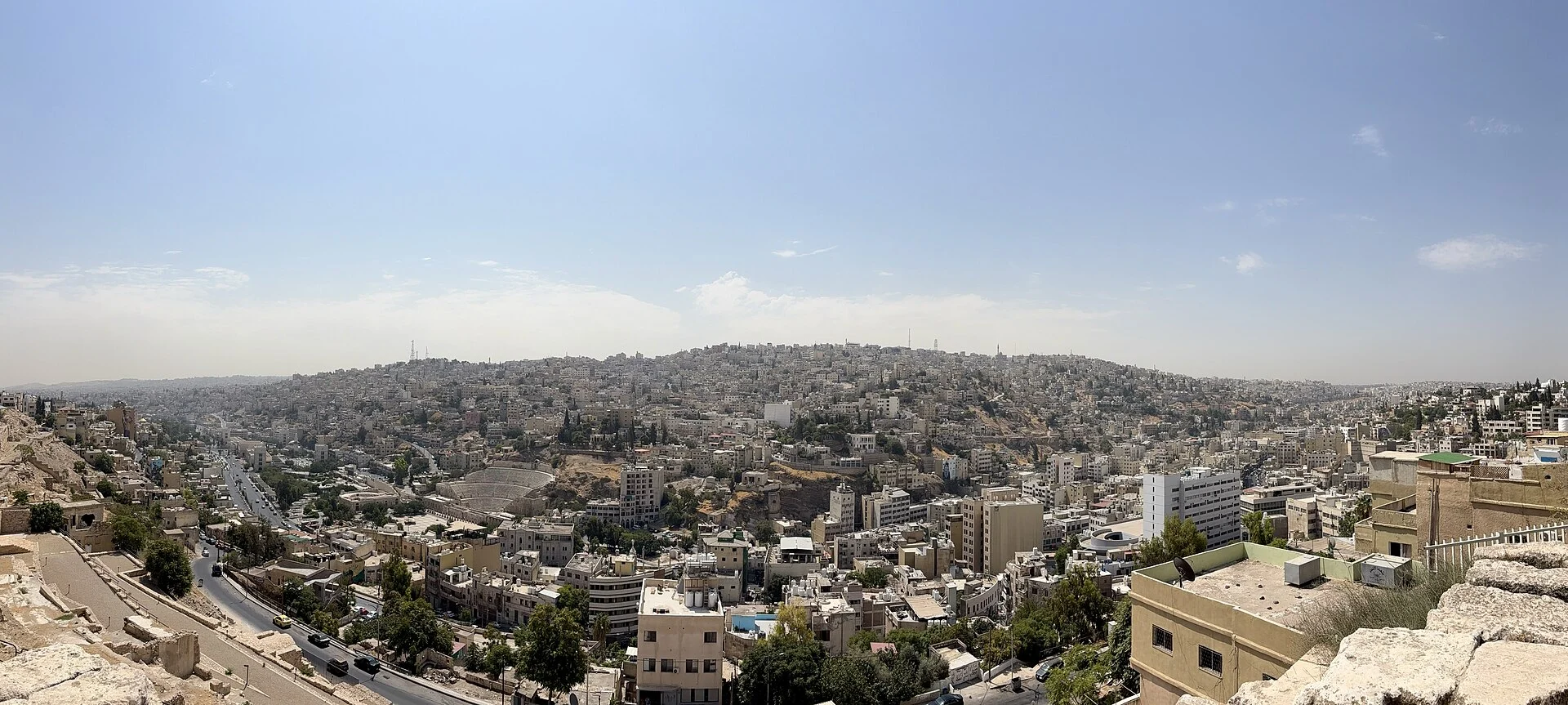
Amman is where almost every trip to Jordan begins and ends, and it is routinely treated as a transit stop between Queen Alia airport and Petra. That is a shame, because it is one of the more interesting capitals in the region: a city built across a spread of steep hills, layered over a settlement that has been occupied more or less continuously since the Neolithic.
The Romans knew it as Philadelphia and made it one of the cities of the Decapolis. Before that it was Rabbath Ammon, capital of the Ammonites. For most of the Ottoman period it was a village; it became a capital only in the 1920s, and then grew very fast, absorbing successive waves of people displaced by regional conflict. That history is why the city feels newer than its foundations and why its neighbourhoods differ so sharply from one another.
It sits high — much of the city is between 700 and 1,100 m — which means real winters, occasional snow, and cool evenings even in summer.
Why Visit
For the Citadel, where the layers are all visible at once on a single hilltop: the Roman Temple of Hercules, a Byzantine church, and the Umayyad Palace complex with its reconstructed dome, looking out over the whole basin of the city.
For the Roman Theatre cut into the hillside downtown, still seating several thousand and still in use, with the modern city pressing right up against it.
For al-Balad, the downtown, which is a working Arab city centre rather than a heritage quarter: spice merchants, gold souks, juice stands, and the queue outside Habibah for knafeh that has not shortened in decades.
And because Amman is the base from which Jerash, the Dead Sea, Madaba and Mount Nebo are all comfortable half-day trips. Jerash in particular is among the best-preserved Roman provincial cities anywhere, and it is under an hour away.
Best Things to Do
- The Citadel (Jabal al-Qal’a): Temple of Hercules, Umayyad Palace, and the Jordan Archaeological Museum. Go late in the day for the light and the call to prayer rising from the whole city at once.
- The Roman Theatre: 2nd century CE, cut into the hillside, with two small museums in the wings.
- Al-Balad (downtown): the souks, the Grand Husseini Mosque, and the best street food in the city.
- Rainbow Street and Jabal Amman: cafes, small galleries, and the Friday-morning Souk Jara market in summer.
- Jabal al-Weibdeh: the arts quarter: Darat al Funun, independent galleries, and the quietest good coffee in the city.
- King Abdullah I Mosque: the blue-domed mosque, and the one in Amman that welcomes non-Muslim visitors outside prayer times.
- The Jordan Museum: holds some of the Dead Sea Scrolls and the ‘Ain Ghazal statues, among the oldest large-scale human figures ever found.
Map
Map data © OpenStreetMap contributors
Best Time to Visit
Spring (March–May) and autumn (September–November) are the comfortable seasons, and they coincide with the best conditions at Petra and Wadi Rum.
Summer is hot but dry, and Amman’s altitude takes the edge off the evenings in a way the Jordan Valley never gets. Souk Jara and the outdoor cafe culture are at their best.
Winter is genuinely cold, with rain and occasional snow that can briefly shut the city’s steep streets. Buildings are often poorly heated. It is also the quietest and cheapest time.
If your trip falls in winter, the pairing is obvious: cold nights in Amman, warm days an hour away at the Dead Sea, which sits more than 400 m below sea level.
Where to Stay
Jabal Amman for a first visit: walkable to Rainbow Street, close enough to descend into downtown, and where most of the small character hotels are.
Al-Balad for budget travel and for being in the middle of the noise and the food. Steep, loud, and the most alive.
Jabal al-Weibdeh for a quieter version of the same idea, with better coffee.
Abdoun or Sweifieh if you are here for business or want international-standard hotels, accepting that you will take a car everywhere.
One practical note: hills. Check where your hotel sits relative to where you intend to walk, because a 400-metre distance on the map can be a hundred steps up.
Neighborhoods
Al-Balad (downtown): the historic centre in the valley: souks, the Roman Theatre, cheap eating, and steep stairs in every direction. Lively by day, quieter at night.
Jabal Amman: the hill above downtown, with Rainbow Street, restored 1920s houses, boutique hotels and most of the visitor-facing cafes. The best base for a short stay.
Jabal al-Weibdeh: next hill over, older, greener and more residential, with the city’s art scene and a slower pace.
Abdali: the new downtown: towers, a boulevard, malls. Modern Amman as it wants to be seen.
Sweifieh and Abdoun: west Amman, affluent and international, with the restaurant and nightlife scene. Far from the historic sites and reliant on taxis.
The pattern is simple once you see it: the east is older, denser and cheaper, the west newer and wealthier, and the two feel like different cities.
Transportation & Airports
Queen Alia International (AMM) is about 35 km south of the city, roughly 40 minutes by road outside rush hour. The Sariyah airport express bus runs to Tabarbour terminal at a fraction of taxi fares; taxis and ride-hailing apps are the simpler option with luggage.
Ride-hailing apps work well and are the easiest way to move around, mainly because they remove the negotiation. Metered yellow taxis exist and the meter is not always used.
The Amman Bus (BRT) network has expanded considerably and is cheap, though route knowledge helps.
Walking is pleasant within a neighbourhood and unrealistic between them. Amman is built on hills, and the gradient between al-Balad and Jabal Amman is severe — there are public staircases precisely because the streets are impractical on foot.
Intercity. JETT coaches run from Amman to Petra, Aqaba and the Dead Sea. For Jerash and the north, shared taxis and buses leave from the northern terminals.
Food
Amman eats well and cheaply. Downtown is where to start.
Knafeh: shredded pastry over melted cheese, drenched in syrup — is the city’s signature sweet, eaten standing up and hot. Habibah in al-Balad is the institution, and the queue moves fast.
Hummus and falafel for breakfast is the normal way to start a day, not a snack. The downtown places that open at 07:00 and sell out by noon are the ones to look for.
Mansaf, the national dish of lamb in fermented dried yoghurt over rice, is a communal meal rather than a plate. Restaurants that serve Jordanians rather than visitors do it properly.
Shawarma in the evening, from a stand with a queue.
West Amman has the contemporary restaurant scene: Levantine cooking done seriously, plus everything international. It costs several times what downtown does and is often worth it.
Day Trips
Jerash: under an hour north, and the reason to give Amman an extra day. A Roman provincial city with a colonnaded street, two theatres, temples and an oval forum, preserved to a degree that is genuinely rare.
The Dead Sea: about an hour west and 400 m below sea level. Day-use passes at the resort beaches include showers, which matter more than you expect: the water is around ten times saltier than the ocean and needs to be washed off.
Madaba and Mount Nebo: 30–45 minutes south. Madaba’s 6th-century mosaic map of the Holy Land is the oldest surviving cartographic depiction of the region; Mount Nebo looks across to Jericho and the Jordan Valley.
The Desert Castles: Umayyad hunting lodges and caravanserais east of the city, notably Qasr Amra with its frescoes. A half-day loop by car.
Ajloun: a 12th-century Ayyubid castle built to watch the routes against the Crusaders, in green hill country that looks nothing like the rest of Jordan.
Budget
Amman is the cheapest part of a Jordan trip and the place where the cost difference between east and west is most obvious. A downtown breakfast of hummus, falafel and tea costs a fraction of a west Amman brunch, and both are worth doing.
The Jordan Pass covers the Citadel, the Roman Theatre and Jerash among its forty-plus sites, so if you hold one, most of Amman’s sightseeing is already paid for.
Taxis and ride-hailing are inexpensive by regional standards and you will use them constantly — budget for movement rather than distance. Cards work in west Amman and hotels; downtown and the souks are cash.
Travel Tips
Give Amman a full day, not a night. The Citadel, the theatre and downtown fit comfortably into one, and Jerash justifies a second.
Use the airport bus if you are travelling light. It is a fraction of the taxi fare and runs regularly.
Friday morning is quiet. Many businesses close for prayers; downtown wakes up in the afternoon.
The stairs are shortcuts. Amman’s public staircases connect hills that the road network takes ten minutes to link.
Carry small notes. Taxi drivers and downtown stalls rarely have change for large dinars.
Dress for the hills and the season: Amman in January is cold in a way visitors expecting a desert climate are not prepared for.
Frequently Asked Questions
Is Amman worth staying in, or should I go straight to Petra?
Worth at least one full day. The Citadel, the Roman Theatre and downtown make a strong day, and Jerash is under an hour away.
How far is the airport?
Queen Alia International is about 35 km south, roughly 40 minutes outside rush hour. There is an express bus as well as taxis.
Is Amman walkable?
Within a neighbourhood, yes. Between neighbourhoods, no: the city is built on steep hills and you will use taxis.
Can I visit the Dead Sea from Amman?
Yes, about an hour each way. Resort day passes include the showers you will want afterwards.
Which neighbourhood should I stay in?
Jabal Amman for a first visit, al-Balad for budget and atmosphere, Jabal al-Weibdeh for quiet.
Does the Jordan Pass cover Amman?
It includes the Citadel, the Roman Theatre and Jerash among its sites.